Changing Careers in Your 30s or 40s? You Need a Realistic Plan
Have you ever looked at your job and wondered, “Is this really what I want to do for the rest of my life?” Many people reach their 30s or 40s and start questioning their career path. They may want more flexibility, better pay, greater purpose, or a completely different lifestyle. Others may dream of starting a business or moving into a new industry. The truth is, changing careers later in life is more common than many people think. However, passion alone is usually not enough. Career changes often involve financial planning, learning new skills with degrees from institutes like MANCOSA, and finding ways to use your existing experience in a different field. The good news? A career change does not always mean starting over. With the right education, transferable skills, and a realistic strategy, you can build a career that better aligns with your goals and plans. This article explores the realities of changing careers in your 30s or 40s, practical steps for making the transition, and how further education can support your next move.

Authors

MANCOSA
It’s never too late to pursue your dream career
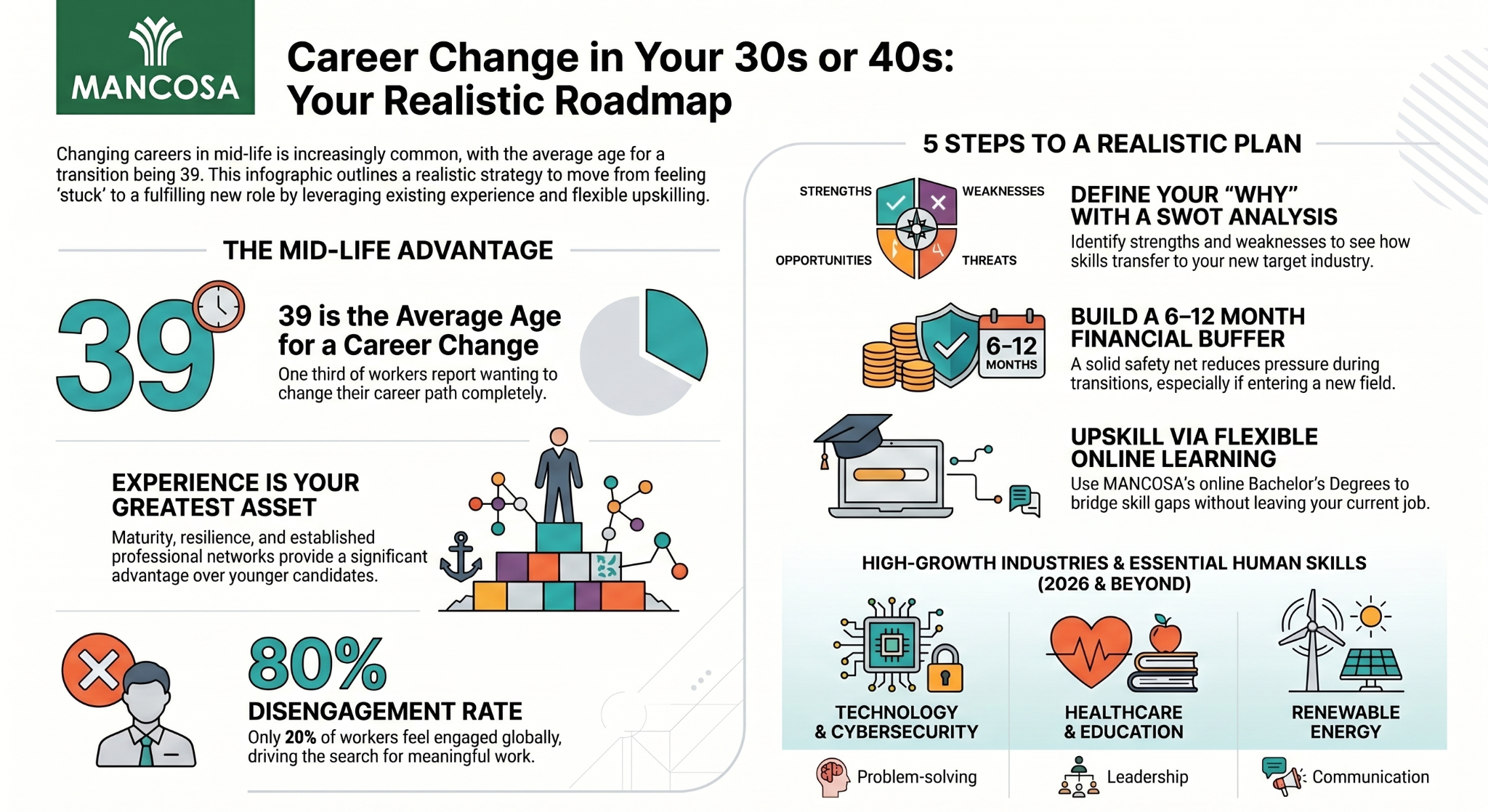
If you feel unhappy, stuck, or unfulfilled in your current job, you aren’t alone. Many people rethink their careers in their 30s and 40s. In fact, workforce research suggests the average age for a career change is around 39.
So, is it common to change careers in your 30s?
Yes. Career changes are becoming more common as people seek better work-life balance, higher income, flexibility, or more meaningful work. Research also shows that 33% of workers in some studies want to change careers completely.
There are many facts about changing careers in your 40s that challenge old beliefs. For example, people who changed careers later in life often report higher job satisfaction and improved well-being.
However, changing careers requires planning. Responsibilities such as children, mortgages, and financial commitments often make career changes more complex in midlife.
That’s why an actionable plan for a midlife career change matters.
5 Key tips for making a career change in your 30s, 40s, or beyond
Changing careers in midlife can feel exciting and terrifying at the same time. You may worry about money, experience, age, or starting over.
But changing direction doesn’t mean losing everything you have built. In many cases, your years of experience become your biggest advantage.
Here are some practical steps for changing careers midlife successfully:
1. Understand why you want to change careers
Before updating your CV or enrolling in a course, ask yourself: Why do I want this change?
Do you want:
- Better work-life balance?
- Higher income?
- More meaningful work?
- Greater flexibility?
- To become your own boss?
Your answer shapes your next steps.
Pro tip: Write down your strengths, weaknesses, opportunities, and threats (SWOT analysis). You may realise skills from your current career transfer surprisingly well.
For example, a teacher moving into corporate training already has communication, presentation, and leadership skills.
2. Stop thinking you are starting from zero
Many people underestimate transferable skills.
Project management, problem-solving, communication, leadership, sales, writing, customer service, and budgeting matter in almost every industry.
Imagine a 42-year-old marketing manager wanting to launch a consulting business. They aren’t starting over. They already understand clients, strategy, deadlines, and business operations.
Your experience has value.
3. Fill skill gaps with education or certifications
One of the biggest hurdles during career changes is a lack of industry-specific knowledge.
Learning new skills can increase confidence and credibility. Flexible online qualifications, certifications, and short courses make studying easier while working.
For example, a 38-year-old accountant may want to move into tech. Instead of applying immediately with no experience, they complete an IT qualification while building small projects. Their transition becomes much smoother.
4. Build a financial safety net before making big moves
Career changes sometimes involve temporary pay cuts.
This is especially true if you:
- Start a business
- Study full-time
- Enter a new industry
- Freelance while building experience
Create savings covering at least 6–12 months of essential expenses if possible.
Planning reduces pressure and helps you make better decisions.
5. Network before you need opportunities
Many jobs and business opportunities come through relationships.
Talk to people already working in your target industry. Ask questions. Learn what daily work looks like. Seek mentors.
Knowing how to successfully change careers in your 40s often comes down to insight from people who have done it before.
One encouraging reality: career satisfaction matters. Yet many workers remain disengaged globally, with engagement levels dropping to around 20% in 2025. This suggests many people are searching for more meaningful work.
Final thought: Age can be an advantage
One of the biggest tips for starting a new career at 35 or older without experience is to stop seeing age as a disadvantage.
Older career changers often bring maturity, resilience, professional networks, and workplace experiences that younger candidates may not have.
Changing careers is rarely a straight path. There may be setbacks. But with realistic planning, continuous learning, and patience, a career pivot can become one of the most rewarding decisions you make.
Why an online Bachelor’s Degree at MANCOSA can help you switch careers
Changing careers often means learning new skills or gaining qualifications that match your future goals. Studying towards a qualification can help build confidence, improve credibility, and open doors to new industries.
MANCOSA’s Bachelor’s Degrees are designed to help students develop practical, industry-relevant knowledge across fields such as business, management, education, and technology.
For people making a midlife career change, flexible online learning makes it easier to study while balancing work, family, or other responsibilities.
Depending on your goals, shorter qualifications such as higher certificates may help you build foundational skills.
Meanwhile, diplomas, degrees, and postgraduate qualifications can support professionals wanting to specialise, move into leadership roles, or transition into completely different industries.
Affordable study options, flexible online learning, and qualifications aligned with workplace needs can make re-education more realistic for working professionals.
Rather than seeing education as starting over, it can become a practical step towards building a more fulfilling and sustainable career path.
FAQs
What is the 30-30-30 rule for career change?
The 30-30-30 rule is an informal approach some career coaches use for career transitions. It may involve spending 30 days researching, 30 days building skills or networking, and 30 days taking action.
The idea is to break a big change into manageable steps. Having an actionable plan for a midlife career change can make transitions feel less overwhelming.
How do you know when it’s time to switch careers?
You may need a career change if you constantly feel unmotivated, stressed, stuck, or disconnected from your work.
Other signs include a lack of growth opportunities, poor work-life balance, or a desire to explore a different path. Understanding how to change careers in your 40s successfully starts with recognising when your current role no longer aligns with your goals.
What jobs are doomed and what jobs will boom in 2026 and beyond?
Some repetitive roles may decline due to automation and AI.
However, careers in technology, healthcare, education, renewable energy, cybersecurity, data analysis, digital business, and skilled trades are expected to grow. Human-centred skills like leadership, communication, and problem-solving remain valuable.
What career can I change to at 40?
Many careers welcome professionals with transferable skills. Examples include project management, consulting, education, HR, digital marketing, IT, entrepreneurship, and business leadership.
One of the best tips for starting a new career at 35 or older without experience is to focus on industries where your existing experience still adds value.
Register for a Bachelor’s Degree & more courses online
Changing careers in your 30s, 40s, or beyond can feel risky, but it’s far more common than many people realise.
Whether you want better work-life balance, higher income, more meaningful work, or the opportunity to start your own business, a successful career change usually begins with a realistic plan.
If you’re considering a new direction, qualifications such as flexible online degrees, diplomas, or higher certificates can help you gain