7 Artificial Intelligence Skills Employers Are Looking for
Businesses across industries are now using AI tools to automate tasks, improve decision-making, increase productivity, and better serve customers. Because of this, employers are actively looking for professionals with strong AI knowledge and practical technical skills. In fact, according to PwC, AI could contribute up to $15.7 trillion to the global economy by 2030, making it one of the fastest-growing technology fields in the world. This growing demand means professionals who understand artificial intelligence, machine learning, automation, and data analysis are becoming highly valuable in the job market. However, employers are not only looking for theoretical knowledge. They want candidates who can apply AI tools and technologies to solve real business challenges and improve results. This article explores some of the top artificial intelligence skills employers are looking for, how to showcase these skills on your resume, and how a Postgraduate Diploma in Artificial Intelligence from an institute like MANCOSA can help prepare you for future career opportunities in AI.
Authors

MANCOSA
Why “AI fluency” is the new hiring baseline
Artificial intelligence is no longer seen as a specialised tech skill only used by data scientists or software engineers. Today, AI tools are becoming part of everyday work across industries like:
- Marketing
- Accounting
- Education
- Customer service
- Healthcare
- And business management
In many ways, AI is following the same path as Microsoft Office did in the early 2000s. At that time, employers expected knowledge workers to know how to use tools like Word, Excel, and PowerPoint.
Now, companies increasingly expect employees to understand how to use AI tools to improve speed and productivity. This growing shift highlights the importance of AI fluency in job markets worldwide.
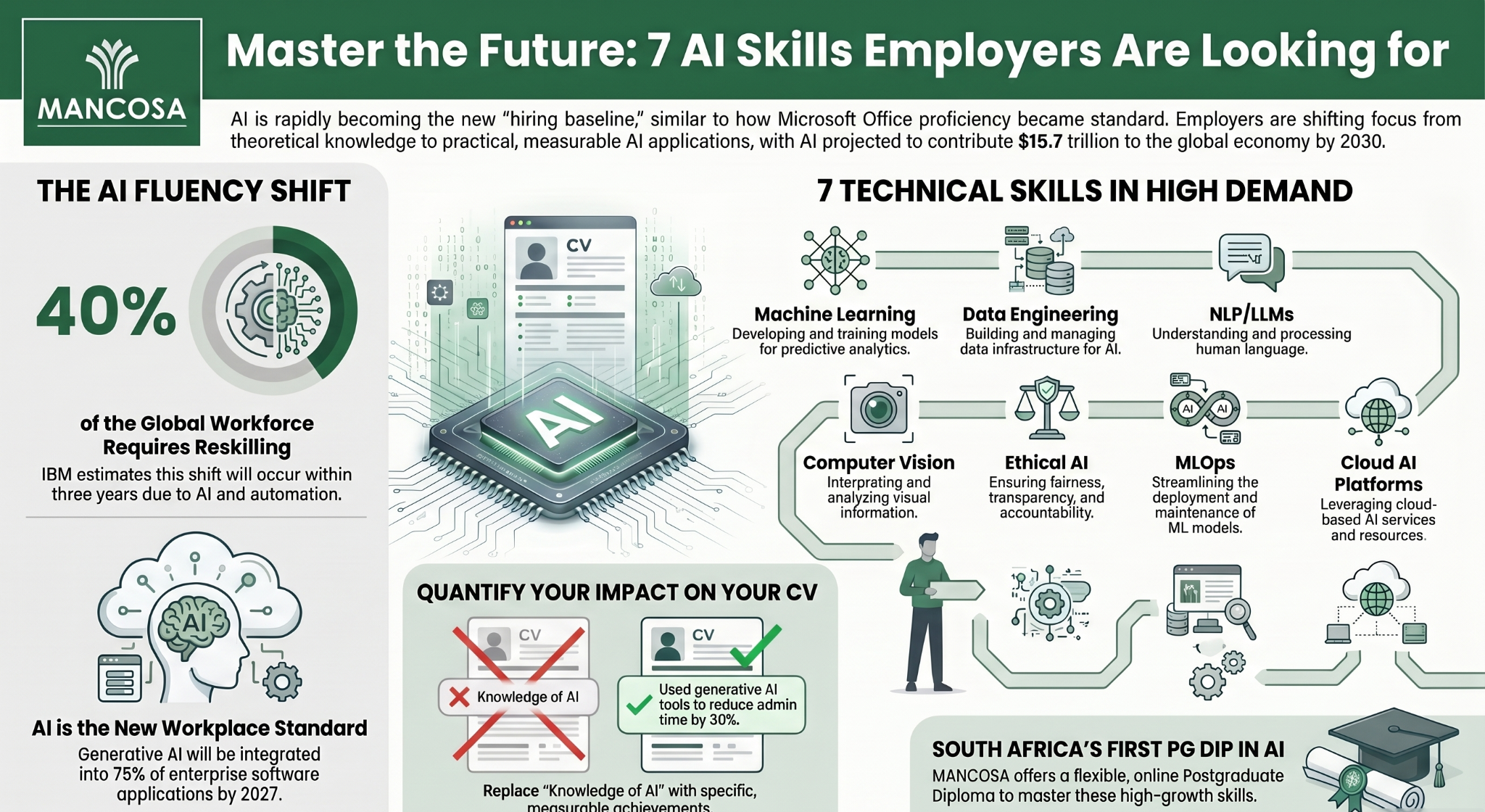
According to IBM, around 40% of the global workforce will need to reskill because of AI and automation over the next three years. At the same time, Gartner predicts that generative AI will be integrated into 75% of enterprise software applications by 2027.
This explains why employers demand AI proficiency in modern workplaces.
Businesses want professionals who can use AI to write reports faster, analyse information, automate repetitive tasks, improve customer experiences, and support better decision-making.
In other words, the AI skills baseline for productivity is quickly becoming a standard expectation rather than a bonus skill on a CV.
7 Top in-demand technical AI skills employers seek
Artificial intelligence is changing the workplace at a rapid pace. Businesses now need professionals who can build, manage, and improve AI systems that solve real business problems. Here are some of the top technical artificial intelligence skills employers seek today:
1. Machine learning and deep learning
Companies want professionals who can train AI models to make predictions, automate tasks, and improve decision-making. To be able to do so, workers need in-demand machine learning skills, such as supervised learning, neural networks, and reinforcement learning.
On top of building these models, employers also value candidates who can explain how their AI models improved business results.
2. Data engineering and data preparation
AI systems rely heavily on clean, high-quality data. Skills in Python, SQL, Pandas, and cloud databases help businesses organise and process massive datasets efficiently. Poor-quality data often leads to poor AI performance, making this skill extremely valuable.
3. Natural Language Processing (NLP) and LLMs
With tools like ChatGPT becoming mainstream, NLP skills are highly valuable. Businesses use these tools for customer support, content creation, and automation.
4. Computer vision
Computer vision helps AI interpret images and videos. It is widely used in healthcare, retail, manufacturing, and security industries. This technology is commonly used in:
- Facial recognition
- Medical imaging
- Security systems
- Manufacturing quality checks
- And self-driving vehicles
For example, hospitals can use computer vision systems to help detect diseases earlier through medical scans. As visual data continues to grow online, demand for these skills is increasing rapidly.
5. Ethical AI and bias detection
Companies are becoming more aware of fairness and transparency in AI systems. Professionals who can reduce bias and improve responsible AI use are increasingly important.
This is especially important in industries such as healthcare, finance, recruitment, and law, where biased AI decisions can have serious consequences.
6. MLOps and AI deployment
Building an AI model is only part of the process. Employers also need people who can deploy, monitor, and scale AI systems using tools like Docker and Kubernetes.
7. Cloud AI platforms
Many businesses use cloud-based AI services because they are faster and more cost-effective than building their own infrastructure from scratch. Skills in platforms like AWS, Microsoft Azure, and Google Cloud help businesses scale AI projects quickly and cost-effectively.
The need for all of these skills can’t be ignored. This is why many students pursue an artificial intelligence course that combines technical theory with practical industry skills and experience.
How to showcase AI skills on your resume (examples)
When applying for AI-related roles, simply listing tools like “Python,” “ChatGPT,” or “machine learning” is no longer enough.
Employers want to see how you use AI to solve problems, improve productivity, or support business goals. This is one of the most important parts of translating AI certification to job impact.
For example, imagine you are applying for a job at a logistics company. Writing “Experienced in Python and TensorFlow” sounds vague. Instead, focus on measurable results and real outcomes.
Here are some stronger ways to showcase artificial intelligence skills on your resume:
- “Used generative AI tools to automate weekly reporting, reducing admin time by 30%.”
- “Developed a machine learning model that improved customer churn prediction accuracy by 22%.”
- “Built a computer vision system using Python and TensorFlow that reduced packaging errors by 15%.”
- “Used AI-powered analytics tools to improve marketing campaign performance and increase conversions.”
This approach helps employers quickly understand the value you can bring to their organisation. Quantifying AI project experience for jobs also makes your resume far more convincing because it demonstrates real business impact rather than just technical knowledge.
Why choose a Postgraduate Diploma in Artificial Intelligence at MANCOSA
MANCOSA offers South Africa’s first Postgraduate Diploma in Artificial Intelligence, designed to help students develop practical and future-focused AI skills.
The programme combines both theoretical and hands-on learning, preparing graduates to design, build, and apply AI systems in real-world business environments.
Students study important AI areas such as:
- Machine learning
- Computer vision
- Computational intelligence
- Programming
- And multi-agent systems
The qualification also includes a research project that helps students apply their knowledge to practical industry challenges.
One of the biggest advantages of studying at MANCOSA is flexibility.
The programme is offered through fully online distance learning, making it ideal for working professionals who want to upskill while continuing their careers. MANCOSA is also known for providing affordable and accessible higher education in South Africa.
Graduates can pursue careers such as AI Analyst, Machine Learning Engineer, AI Developer, or AI Solutions Architect.
Students interested in broader digital technology and leadership skills may also explore related programmes like the Postgraduate Diploma in Information and Technology Management.
FAQs
What are the prerequisites for enrolling in the Postgraduate Diploma in Artificial Intelligence?
Most students applying for a Postgraduate Diploma in Artificial Intelligence need an undergraduate qualification in fields such as Information Technology, Computer Science, Engineering, or another analytical discipline.
Basic programming knowledge, especially Python, can be helpful, but many programmes are designed to help students build foundational AI knowledge step-by-step.
What career opportunities open up after completing an online artificial intelligence course?
An online artificial intelligence course can prepare graduates for careers such as AI Specialist, Data Scientist, Machine Learning Engineer, AI Consultant, and Business Intelligence Analyst.
Artificial intelligence skills are now valuable across industries, including healthcare, finance, logistics, education, retail, and marketing.
Is the MANCOSA Postgraduate Diploma in Artificial Intelligence offered online?
Yes. The MANCOSA postgraduate diploma is offered through a flexible online learning model, allowing working professionals to study while managing their careers and personal responsibilities.
How long does it take to complete the Postgraduate Diploma in Artificial Intelligence?
The qualification is structured to support flexible learning, so completion time may vary depending on study load and whether students study full-time or part-time. But it can take anywhere from 1 to 2 years.
Besides technical skills, what soft skills are essential for an AI career?
Strong communication, critical thinking, creativity, ethical reasoning, and problem-solving are highly important. Employers also value professionals who can explain complex AI concepts clearly to non-technical teams and business leaders.
Register for an AI course at MANCOSA online
Artificial intelligence is transforming the way businesses operate and hire. Employers now want professionals who can combine technical AI knowledge with practical problem-solving and business thinking.
From machine learning and cloud AI platforms to ethical AI and data analysis, these skills are becoming valuable across almost every industry.
As AI adoption continues to grow, professionals who invest in their digital and AI capabilities will be better positioned for long-term career opportunities.
A qualification like the MANCOSA Postgraduate Diploma in Artificial Intelligence can help students build both the technical and practical skills needed to succeed in an increasingly AI-driven world.