5 Careers that will still exist in 2035
Technology is changing the way people work. Artificial intelligence, automation, and digital tools are transforming industries worldwide. Because of this, many students and professionals are asking an important question: what will the job market look like in the future? And will qualifications like a Bachelor’s Degree still be useful? While some roles may disappear or change, many careers will continue to grow. In fact, experts believe the future workforce will place even greater value on skills such as creativity, critical thinking, communication, and leadership.

Authors
MANCOSA
These human abilities are difficult for machines to replace, which means certain professions will remain highly relevant in the years ahead. Understanding future job market predictions can help students choose study paths that lead to stable, rewarding careers.
In many cases, earning an Undergraduate Degree from an institution like MANCOSA and continuously upgrading your skills will remain one of the best ways to stay competitive.
In this article, we explore five careers that are expected to remain relevant in 2035, why these roles will continue to be in demand, and how the right education can help you prepare for the future workforce.
What will the job market look like in 2035?
The world of work is changing quickly. New technologies like artificial intelligence (AI), automation, and advanced robotics are already transforming how businesses operate.
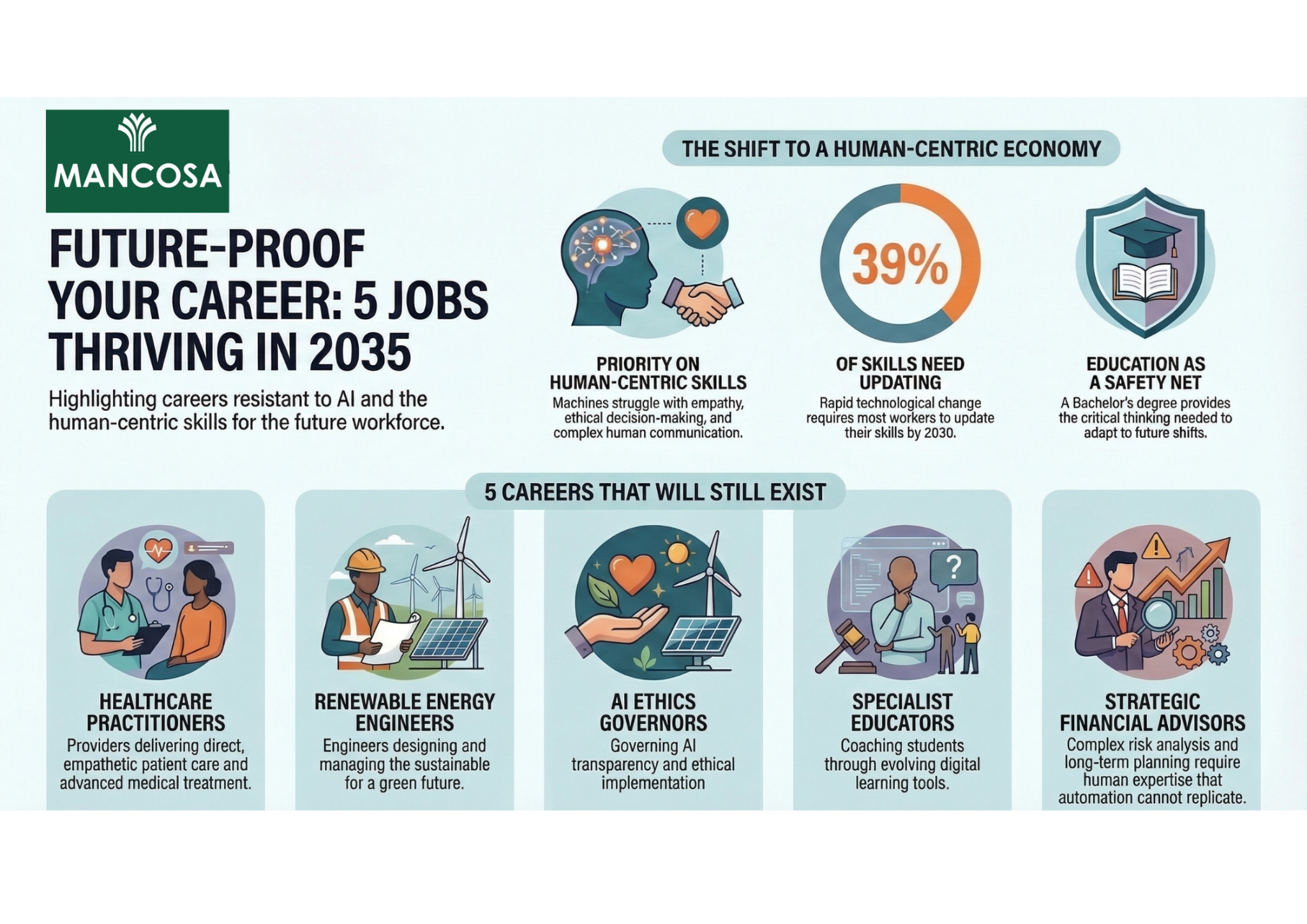
According to the World Economic Forum, around 39% of workers’ skills will need updating by 2030 because of technological change. By 2035, these shifts will likely be even stronger, shaping the types of jobs that remain in demand.
A common future job market prediction for 2035 is that routine and repetitive jobs will continue to decline, while careers requiring creativity, critical thinking, and human interaction will grow.
The rise of the human-centric economy
Even though machines can process data quickly, they still struggle with empathy, ethical decision-making, and complex human communication.
This means jobs that will remain valuable include those that focus on:
- Leadership
- Teaching
- Healthcare
- Counselling
- Innovation
- Strategy
Experts increasingly refer to this shift as education for a human-centric economy, where uniquely human skills become more important than purely technical tasks.
The essential role of education and training
Education will also play a key role in preparing people for these careers. A strong academic foundation, combined with practical digital skills, will help workers adapt to future changes.
Many experts believe that completing a Bachelor’s Degree will continue to provide significant job security through 2035. This is especially true when paired with lifelong learning and short courses in emerging fields.
Students who focus on adaptable skills, continuous learning, and problem-solving will be better prepared to succeed in the evolving job market.
5 Careers that will be relevant in 2035
Technology will continue to change how people work, but many careers will remain important because they rely on human judgment, creativity, and communication. Below are five jobs that won’t be replaced by AI by 2035 because they depend heavily on human expertise.
1. Advanced healthcare practitioners and specialists
Healthcare will remain one of the most important industries in the world. Doctors, specialised nurses, therapists, and mental health professionals provide care that requires empathy and ethical decision-making.
According to the World Health Organization, the world could face a shortage of 11 million healthcare workers by 2030, increasing demand for trained professionals.
By 2035, healthcare workers will likely use advanced technology such as AI diagnostic tools and remote monitoring devices. However, the human connection between patient and practitioner will remain essential.
Learn more about healthcare management trends.
2. Renewable energy engineers and system architects
As countries transition to cleaner energy, renewable energy jobs will grow rapidly. The International Energy Agency predicts that millions of new jobs will be created in renewable energy sectors such as solar and wind power.
In South Africa, the shift toward sustainable energy will require engineers capable of designing and managing complex energy systems. By 2035, these professionals may work with smart grids, advanced battery storage, and cybersecurity systems that protect energy networks.
For example, a graduate with a commerce degree and sustainability training could manage the supply chain for solar infrastructure projects.
3. Ethical AI and data governance specialists
Artificial intelligence is becoming part of many industries, from banking to healthcare. However, AI systems still need human oversight to ensure they’re fair, transparent, and legal. This is where ethical AI specialists and data governance professionals come in.
These professionals help organisations follow regulations, protect personal data, and prevent bias in automated systems. Many roles in this field require both technical and ethical understanding.
This career highlights the importance of interdisciplinary skills for the 2035 job market, combining technology knowledge with law, ethics, and governance.
4. Specialist educators and curriculum designers
Education will continue to evolve, but teachers and learning specialists will remain essential. While technology can help deliver information, human educators play a key role in motivating students and supporting their personal development.
By 2035, educators may spend less time lecturing and more time coaching students, guiding them through digital tools and helping them develop problem-solving skills.
This proves that some jobs that won’t be replaced by AI are those that involve deep human interaction.
5. Complex financial and strategic advisors
Automation is already handling many routine financial tasks. However, strategic decision-making, risk analysis, and long-term financial planning still require human expertise.
Professionals with Degrees such as a Bachelor of Commerce or Bachelor of Business Administration will likely focus more on advising businesses and individuals on complex financial strategies.
Pro tip: To stay competitive, future advisors should develop strong communication, data analysis, and strategic thinking abilities.
Why a MANCOSA Bachelor’s Degree is a great choice for the future
Choosing the right qualification is an important step toward building a stable and successful career. A MANCOSA Bachelor’s Degree is designed to prepare students for a changing job market by combining strong academic foundations with practical, industry-relevant skills.
MANCOSA offers a wide range of accredited undergraduate programmes, including:
- Bachelor of Commerce (BCom)
- Bachelor of Business Administration (BBA)
- Bachelor of Education (B.Ed degree)
- And many more
These programmes help students develop leadership, analytical, and strategic thinking abilities.
One of the biggest advantages of studying with MANCOSA is flexibility. Many programmes are offered through online learning and digital support, allowing students to study from anywhere while balancing work or other commitments.
The institution also focuses on affordable and accessible education, making quality higher education available to a wider range of students.
MANCOSA programmes are designed with modern industries in mind, helping students gain the knowledge and practical skills needed to succeed in today’s competitive workplace.
FAQs
Q. What jobs will be in demand in 2035?
Jobs that require strong human skills are expected to grow the most by 2035. This is because careers that involve creativity, critical thinking, empathy, and communication are difficult for machines to replace.
Examples include advanced healthcare practitioners, renewable energy engineers, specialist educators, ethical AI professionals, and strategic financial advisors.
Many of these future-proof careers requiring a Bachelor’s Degree qualifications will combine technical knowledge with human-centered skills.
For example, someone working in education may combine a Bachelor of Education with digital learning tools, while a finance professional may use data analytics to guide business decisions.
Q. What jobs may be gone by 2035?
Jobs that involve repetitive tasks are the most likely to change or decline. Roles such as basic data entry, routine bookkeeping, and certain assembly-line tasks are increasingly automated. However, this doesn’t mean these jobs will disappear completely.
Instead, workers may shift into roles that involve supervising technology, analysing data, or managing systems. Automation will reshape many industries, but it will also create new opportunities in areas like technology management and digital oversight.
Q. What should I study now to be employable in 2035?
Choosing a strong academic foundation is one of the best ways to prepare for the future job market. Degrees such as a Bachelor of Commerce (BCom) or Bachelor of Business Administration help students build skills in leadership, strategy, and problem-solving.
To stay competitive, students should also develop interdisciplinary skills for the 2035 job market, such as combining business knowledge with data analytics, technology, or sustainability.
Q. Which jobs are best for the future (2035 and beyond)?
The best careers will be those that work alongside technology rather than compete with it. Fields related to healthcare, renewable energy, education, and ethical technology are expected to grow significantly.
These professions rely on human insight and complex decision-making, which is why they are often considered future-proof careers.
Q. Will a Bachelor’s Degree still be valuable in 2035?
Yes. A Bachelor’s Degree will remain an important qualification for many professional careers. It provides training on essential skills such as research, communication, and critical thinking.
Employers also value graduates who show they can learn, adapt, and solve complex problems. Studying through an accredited institution like MANCOSA can help ensure your qualification remains relevant in a rapidly changing world.
Register for an online Bachelor’s Degree
The world of work will continue to evolve as technology advances, but many careers will remain essential. Roles that rely on human judgment, creativity, empathy, and complex problem-solving are expected to stay relevant well into the future.
Preparing for the future job market starts with making smart study choices today. A qualification such as a Bachelor’s Degree can provide the knowledge and critical thinking abilities needed to succeed in these evolving roles.
Ultimately, the most successful professionals in 2035 will be those who embrace change, continue learning, and use their uniquely human skills to work alongside technology rather than compete with it.