5 Key Skills Employees Need to Succeed in 2026
The workplace is changing faster than ever before. Advances in artificial intelligence, automation, and digital transformation are reshaping job roles, redefining productivity, and creating entirely new skill requirements. In this environment, traditional qualifications alone are no longer enough to guarantee success for organisations or individuals. Instead, the ability to adapt, learn continuously, and apply practical skills has become the defining factor of performance and long-term relevance. Which is where MANCOSA’s skills development programmes come in. But, before looking at these types of programmes, it’s useful to know which skills to invest in. This article explores five key skills employees need to succeed in 2026 and beyond, explains why skills are now more valuable than qualifications, and highlights how targeted skills development courses can bridge the growing skills gap.
Authors
MANCOSA
Why skills are more important than qualifications in today’s market
Practical skills are increasingly outweighing traditional qualifications as the primary indicator of workplace readiness.
While degrees and diplomas still matter, employers are recognising that theoretical knowledge alone doesn’t guarantee performance in dynamic, tech-driven environments.
This is why many companies are now prioritising skills-based hiring, better positioning them to innovate and respond to change.
Skill-based hiring has many benefits, including:
- Improved employee performance
- Faster onboarding
- Greater agility
- Stronger retention
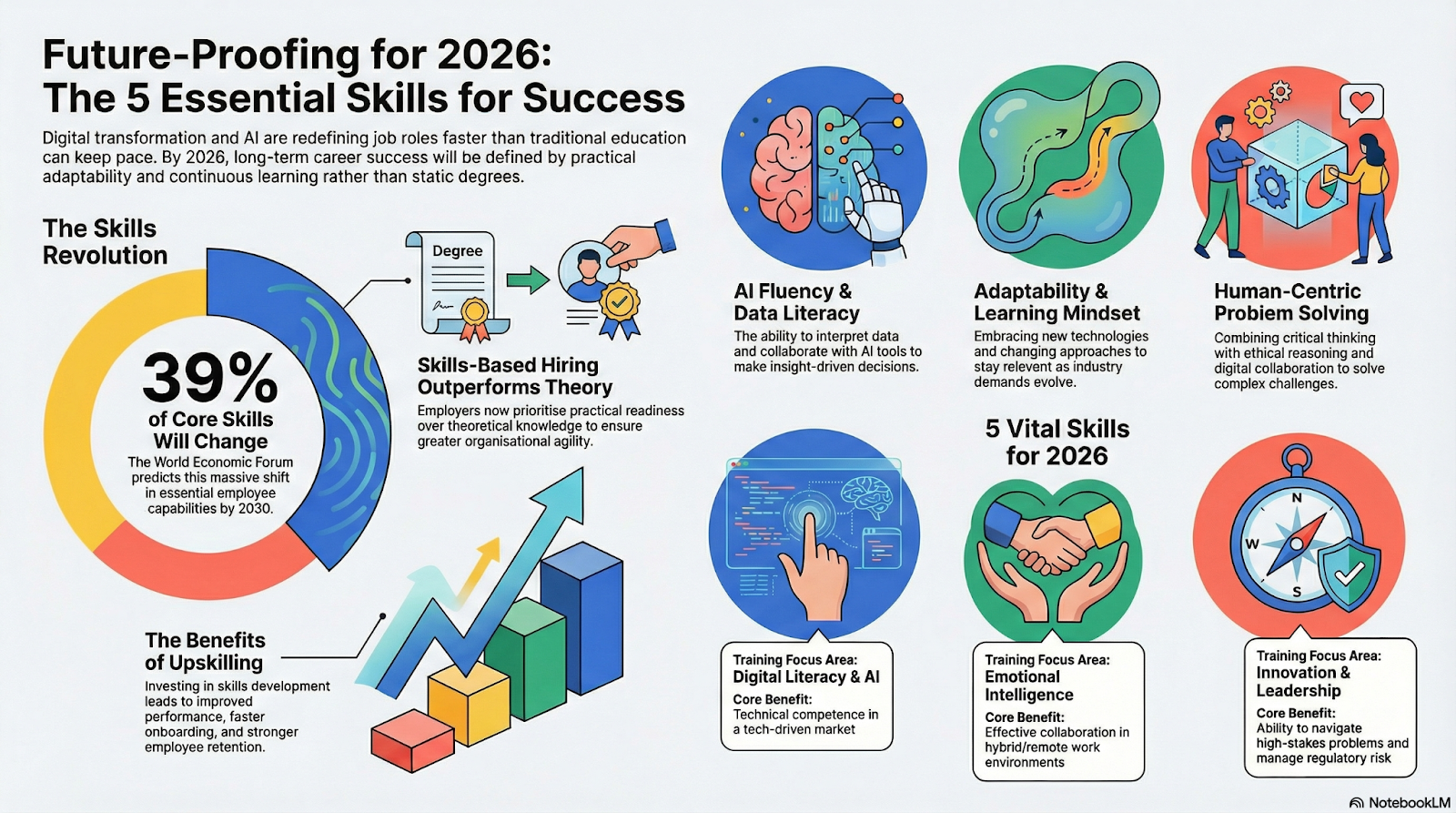
But, according to the World Economic Forum, nearly 39% of all employees’ core skills are expected to change by 2030. This highlights the importance of ongoing skills development.
Unfortunately, many formal training diplomas and degrees can’t keep pace with the rapid pace of digital shifts. This leads to widening skills gaps, where qualified candidates lack the specific capabilities required to perform effectively in modern roles.
As such, understanding how to overcome the skills gap in 2026 is crucial.
Luckily, many businesses and employees have realised that investing in skills development programmes for corporate training is the way to move forward.
These programmes build these skills, which enable both employers and employees to stay competitive in an economy where continuous learning, rather than static qualifications, defines long-term success.
5 Key skills employees need for success in 2026 and beyond
Future-proofing employees with essential skills in 2026 is no longer optional. With technological advancements and changing consumer expectations, it’s a strategic priority. Below are five of the most in-demand soft skills for corporate success in 2026.
1. AI fluency and data literacy
Artificial intelligence is transforming nearly every industry, from digital marketing to supply chain and accounting. According to the World Economic Forum, AI and big data are among the fastest-growing skills globally.
Employees who can interpret data, collaborate with AI tools, and make informed decisions based on insights will outperform those who rely solely on intuition or outdated processes.
Learn how the right artificial intelligence course can shape your future.
2. Adaptability and a learning mindset
Skills required for jobs have changed drastically over the last couple of years, and they continue to change with new advancements and customer behaviours.
This makes the ability to adapt crucial. Employees must be willing to learn and change their approaches.
For example, someone working in the digital marketing space must learn to use AI tools to speed up creation, regardless of their personal feelings towards it. Otherwise, they risk falling behind.
3. Complex problem-solving and critical thinking
While AI can automate routine tasks, human expertise remains essential for solving complicated, high-stakes problems. As such, employees need critical thinking abilities to be able to come up with innovative solutions.
4. Creative collaboration and digital communication
With hybrid and remote work now standard, employees must be able to collaborate effectively across digital platforms. This requires:
- Strong digital communication
- Emotional intelligence
- And cross-functional teamwork
All of which ensures maximum productivity.
5. Ethical reasoning and governance
As businesses increasingly rely on data and automation, ethical decision-making is becoming increasingly vital.
Organisations with strong governance and ethical frameworks are better positioned to maintain trust and manage regulatory risk. Additionally, transparency within a company can lead to higher employee retention and a better overall company culture.
What to expect from skills development courses at MANCOSA
MANCOSA offers a diverse range of skills development programmes designed to equip employees and organisations with practical, industry-relevant capabilities for today’s evolving workplace.
These programmes include accredited online qualifications, corporate training solutions, and short learning programmes. All of which are tailored to meet organisational and individual development needs.
One of the key strengths of MANCOSA’s approach is flexibility. Learners can choose from fully online programmes, customised workshops, and short courses. This makes it easier to balance work responsibilities with professional development.
This flexible delivery model enables organisations to upskill teams efficiently while ensuring learning remains relevant to industry trends.
MANCOSA’s skills development offerings cover areas such as:
- Leadership
- Digital literacy
- Innovation
- Emotional intelligence
- Business skills
All of which focus on practical application and real-world relevance.
Explore MANCOSA’s corporate training solutions here:
FAQs
What skills are actually worth learning in 2026?
For someone entering the workforce in 2026, the most valuable skills are those that complement AI rather than compete with it. Focus on adaptability, complex problem-solving, digital literacy, and foundational AI fluency.
These capabilities help new professionals contribute meaningfully from the start and align with the most in-demand soft skills for corporate success in 2026.
Flexible skills training courses can accelerate this learning and improve job readiness.
What skills should I focus on in 2026–2030 to future-proof my career?
To future-proof your career through 2030, prioritise continuous learning in areas such as ethical reasoning, digital communication, and advanced collaboration.
Developing a growth mindset and engaging in targeted training are key to future-proofing employees with essential skills in 2026 and beyond.
What will be the most in-demand skills in 2026 if AI continues growing?
If AI continues to expand, distinctly human capabilities such as strategic thinking, creativity, emotional intelligence, and ethical decision-making will become even more valuable. Technical skills like data interpretation and AI application will also remain critical.
How can businesses measure the ROI of employee skills development courses?
Businesses can measure ROI by tracking indicators such as improved productivity, higher retention, faster project delivery, and stronger innovation outcomes.
These metrics highlight the benefits of employee skills development courses for businesses and demonstrate how skills-first strategies drive measurable results.
Are online courses a good option for professional skills training?
Yes. Online skills development courses offer flexibility, affordability, and practical relevance, making them an effective alternative for targeted professional training.
They enable individuals and organisations to close skills gaps faster.
Register for a skills development course with MANCOSA
As organisations and professionals prepare for 2026 and beyond, one reality is clear: success will be defined less by formal qualifications and more by practical, adaptable skills.
The rapid pace of technological change, the rise of AI, and the shift toward hybrid work models are reshaping what it means to be “job-ready.”
Targeted skills courses offer a practical solution to bridging the skills gap. They enable organisations to upskill their workforce efficiently while providing employees with relevant, job-ready abilities that can be applied immediately.
Have a look at MANCOSA’s flexible, industry-aligned skills development programmes to remain competitive in a fast-changing world.