Leading with EQ
Strong leadership is about more than making decisions and achieving business goals. Today's leaders also need the emotional intelligence to build trust, motivate employees, and navigate change with confidence. As workplaces become more digital and fast-paced, emotional intelligence (EQ) has become one of the most valuable leadership skills.

Authors

MANCOSA
Leaders who communicate with empathy and build positive relationships are better equipped to create engaged, productive teams.
That’s where a leadership programme, such as MANCOSA’s 21st Century Manager Development Programme, comes in. It equips professionals with key business skills needed in today’s business environment, including emotional intelligence.
In this article, we’ll look at what emotional intelligence is, why it matters in modern leadership, the five core components of EQ, and how developing these skills can help you become a more effective manager.
What is emotional intelligence?
Emotional intelligence is the ability to recognise, understand, and manage your own emotions while also understanding how other people feel.
It helps leaders communicate clearly, handle conflict calmly, build trust, and make better decisions under pressure. While technical knowledge and experience are still important, they are no longer enough on their own.
Beyond soft skills: EQ as a strategic business asset
Today, emotional intelligence has become a strategic business skill rather than simply a “soft skill.” Leaders are expected to guide teams through constant change, support employee wellbeing, and manage increasingly diverse and hybrid workplaces.
These challenges require empathy, self-awareness, and strong relationship-building skills that technology cannot replace.
The human edge in a tech-forward landscape
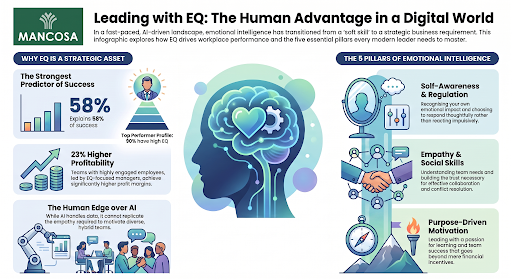
As artificial intelligence automates more technical and repetitive work, human skills have become even more valuable. AI can analyse data and improve efficiency, but it cannot genuinely understand emotions, motivate employees, or build trust.
According to the World Economic Forum, emotional intelligence is one of the workplace skills that employers continue to value more as AI reshapes the future of work.
Research also shows that emotional intelligence has a measurable impact on performance.
In fact, TalentSmart found that emotional intelligence is the strongest predictor of workplace performance, explaining 58% of success across different jobs, while 90% of top performers score highly for emotional intelligence.
For modern leaders, emotional intelligence is no longer optional. It’s the human advantage that enables organisations to build resilient teams and navigate uncertainty.
The 5 core components of emotional intelligence
Emotional intelligence has five key skills. Together, they help leaders communicate better, make smarter decisions, and build stronger teams. If you’re wondering why emotional intelligence is essential for modern managers, these five components provide the answer.
1. Self-awareness
Self-awareness is when you’re able to recognise your own emotions and understand how they affect your thoughts, behaviour, and decisions.
For example, imagine you’re about to give feedback after a stressful meeting. A self-aware leader realises they’re frustrated and takes a few minutes to calm down before speaking. This leads to a more productive conversation instead of damaging team morale.
Self-aware leaders also make better decisions because they separate emotions from facts. This helps them stay objective, even under pressure.
Pro tip: Before making an important decision, ask yourself: “Am I reacting to the situation or responding thoughtfully?”
2. Self-regulation
Self-regulation is when you can manage your emotions instead of letting them control you.
This is especially important in fast-moving businesses where unexpected problems happen every day. The role of self-regulation in high-stakes corporate environments is to keep teams calm and focused during uncertainty.
Instead of reacting with anger or panic when a project goes off track, emotionally intelligent leaders stay composed, communicate clearly, and focus on solutions.
Research by the American Psychological Association shows that employees experience less stress and greater trust when leaders remain calm and supportive during challenging situations.
3. Motivation
Highly emotionally intelligent leaders are motivated by more than promotions or bonuses. They are driven by purpose, learning, and helping their teams succeed.
That positive attitude spreads throughout the workplace. Employees become more resilient, take ownership of their work, and stay engaged during difficult projects.
According to Gallup, teams with highly engaged employees experience 23% higher profitability than teams with low engagement, showing how motivated leadership can improve business performance.
4. Empathy
Empathy means understanding how other people feel and responding with genuine care.
An empathetic manager notices when a normally productive employee seems overwhelmed.
Instead of assuming they’re underperforming, they start a conversation to understand what’s happening and offer support.
This approach strengthens trust, improves wellbeing, and is essential for building high-performing teams through empathetic leadership.
5. Social skills
Social skills bring all the other EQ abilities together. They help leaders communicate clearly, resolve conflict, build relationships, and encourage collaboration across teams.
Leaders with strong social skills create workplaces where people feel comfortable sharing ideas, solving problems together, and working toward common goals.
Where MANCOSA’s leadership courses come in
With leadership skills in greater demand than ever before, MANCOSA offers several leadership courses (as part of corporate training solutions) that help true leaders develop key business skills, such as emotional intelligence.
The 21st Century Manager Development Programme in particular equips managers with the skills and tools needed to succeed in today’s fast-paced work environment.
Inside, employees learn:
- Mindset shifts
- Effective planning and time management strategies
- How to apply different leadership styles
An added benefit is that this course, along with MANCOSA’s other leadership programmes, can be taken online. This means employees can learn while working.
You can also explore other leadership courses, including, but not limited to:
- Digital and Innovation Leadership Programme
- Emerging Leaders Development Programme
- Women in Leadership Accelerator Programme
- Next Gen Retail Development Programme
FAQs
What does it mean to be leading with EQ?
Leading with EQ means using emotional intelligence to guide how you communicate, make decisions, and support your team. Instead of reacting emotionally, high-EQ leaders stay aware of their own feelings while recognising the needs of others.
This helps them build trust, resolve conflict, and lead with empathy. It also explains why emotional intelligence is essential for modern managers, especially in today’s fast-changing and technology-driven workplace.
What are the 5 pillars of emotional intelligence?
The five pillars of emotional intelligence are self-awareness, self-regulation, motivation, empathy, and social skills.
Together, these skills help leaders understand themselves, manage pressure, inspire others, build stronger relationships, and communicate effectively.
Learning how to develop emotional intelligence for business leadership starts with strengthening each of these areas over time through practice, feedback, and continuous learning.
What is an example of a leader with a high emotional intelligence?
Imagine a project suddenly falls behind schedule. Instead of blaming the team, a leader with high EQ stays calm, listens to employees’ concerns, and works with them to find solutions.
By showing empathy and communicating openly, they keep morale high and encourage collaboration. This approach is key to building high-performing teams through empathetic leadership.
What are the 5 C’s of emotional intelligence?
The 5 C’s of emotional intelligence are Consciousness, Control, Commitment, Compassion, and Collaboration.
They build on the core emotional intelligence skills by encouraging leaders to become more self-aware, manage emotions effectively, stay purpose-driven, show empathy, and work well with others.
Together, these qualities create stronger workplace relationships and improve leadership effectiveness.
How does investing in emotional intelligence training benefit corporate teams?
Emotional intelligence training helps leaders communicate more effectively, manage conflict, and support employee wellbeing. As a result, organisations often experience stronger collaboration, better decision-making, and higher employee engagement.
Many businesses are now improving team performance with emotional intelligence training because it helps create more resilient and productive teams while supporting long-term business success.
Register for leadership courses online with MANCOSA
Leading with emotional intelligence is no longer optional. It’s a key leadership skill in today’s workplace.
By developing self-awareness, empathy, and strong communication skills, leaders can build more engaged and high-performing teams while creating lasting business success.
Explore MANCOSA’s leadership courses, such as the 21st Century Manager Development Programme, and equip yourself or your team with EQ skills today.