The Importance of Self-Awareness in Leadership
Good leadership starts with understanding yourself. Leaders make decisions every day that affect their employees, teams, and the wider business. But without self-awareness, they may not realise how their emotions, communication style, or behaviour affect the people around them. This is why self-awareness in leadership is so important. For businesses, developing self-aware leaders through programmes like MANCOSA’s Emerging Leaders Development can support better communication and stronger teams.

Authors

MANCOSA
In this article, we look at the importance of self-awareness in leadership, why it matters in today’s workplace, and how businesses can help their current and emerging leaders develop this valuable skill.
3 Reasons self-awareness in leadership is essential today
Modern leaders face constant change. They need to manage different personalities, make difficult decisions, communicate clearly, and help their teams perform under pressure.
As a result, technical knowledge alone isn’t enough. Leaders also need self-awareness, as one of many great leadership qualities.
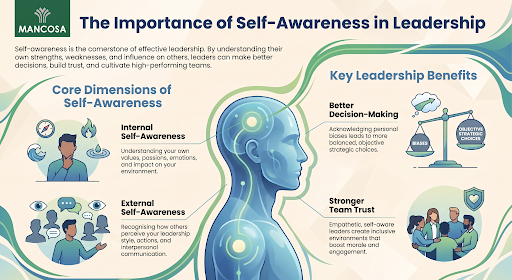
This means understanding their own strengths, weaknesses, emotions, behaviours, and impact on other people.
This matters because managers can have a major influence on the people they lead. In fact, according to Gallup research, managers account for 70% of the difference in team engagement.
In other words, your employee engagement directly relies on the quality of leadership.
Here are three reasons why developing strong, self-aware leaders is critical.
1. Self-awareness helps leaders identify their blind spots
People don’t always see themselves the same way others see them.
For example, a manager may believe they’re being confident and decisive. Their employees, however, may experience their communication style as controlling or dismissive.
This is where psychometric assessments can be useful for building self-aware leadership teams. These assessments can help leaders better understand their personalities, behaviours, strengths, and possible areas for development.
Businesses can also use 360-degree feedback, in which leaders receive input from several people they work with. The Center for Creative Leadership explains that these assessments can help leaders identify strengths, weaknesses, and important blind spots.
Pro tip: Assessments shouldn’t just be used to label people. Combine the results with coaching and practical development plans so leaders know what to work on.
2. Self-awareness can help leaders build stronger teams
One of the major benefits of self-awareness training for leadership teams is that it can help leaders understand and manage their emotions.
Imagine a sales manager whose team has a high staff turnover rate. The manager believes employees simply cannot handle pressure. However, feedback shows that the manager becomes overly critical and demanding when targets are missed.
Once the manager recognises this behaviour, they can work on communicating more calmly and listening to employees before reacting.
This can contribute to a more empathetic workplace, which is highly important to workers.
According to Businessolver’s 2026 State of Workplace Empathy research, 66% of employees would take less pay for a more empathetic workplace.
As such, self-awareness can help leaders create healthier relationships with employees and potentially support stronger retention.
3. Self-awareness helps prepare leaders for change
Businesses are constantly adapting to new technologies, customer expectations, economic pressures, and ways of working.
Leaders need to adapt too.
Understanding how to develop self-aware leaders for 21st-century business can help organisations build a stronger leadership pipeline.
Self-aware leaders are more likely to recognise when an old approach is no longer working. They can acknowledge gaps in their knowledge and adjust their behaviour when necessary.
Instead of thinking, “I’ve always done it this way,” they can ask, “Is there a better way to handle this?”
This mindset can make it easier for leaders and their teams to learn and respond to change.
Where MANCOSA’s leadership courses come in
Building self-aware leaders takes time and the right training. This is where MANCOSA’s corporate training solutions, like the Emerging Leaders Development programme, can help.
These programmes are designed for businesses that want to invest in their employees and build stronger teams. Companies can use the leadership skills training to help current and emerging leaders develop practical skills for the modern workplace.
Some key benefits of these courses include that they’re online and flexible, meaning employees can study while working. Plus, the training can also be customised around a company’s specific needs and skills gaps.
Finally, the programmes are also designed with the future of work in mind. By developing relevant leadership and business skills, companies can help their employees adapt to changing roles, technologies, and workplace demands.
Explore the Leadership Development Programmes here.
FAQs
What is the importance of self-awareness in leadership?
Self-awareness helps leaders understand their strengths, weaknesses, emotions, and behaviour. It also helps them see how their actions affect other people. This can lead to better communication, stronger relationships, better decisions, and more trust within teams.
What are the five important aspects of self-awareness?
Five important benefits of self-awareness are:
- Better emotional intelligence
- Stronger decision-making
- Less conflict
- Improved employee retention
- And continued leadership development
Together, these can help leaders manage people more effectively and respond better to workplace challenges.
What are the 7 insights of self-awareness?
Seven useful areas leaders can become more aware of are their values, passions, aspirations, fit, patterns, reactions, and impact. Understanding these areas can help leaders recognise what drives their behaviour and how that behaviour affects others.
What are the 4 pillars of self-awareness?
Self-awareness can be viewed through four areas:
- Understanding your own thoughts and values.
- Recognising your emotions and reactions.
- Understanding how other people see you.
- And recognising the impact your behaviour has on them.
How can companies foster self-awareness in their leadership teams?
Companies can provide regular feedback, coaching, leadership training, and psychometric assessments for building self-aware leadership teams.
These tools can help employees identify blind spots and understand where they need to improve. Ongoing professional development can then help them turn these insights into stronger leadership skills.
Register for a leadership course with MANCOSA
Self-awareness is an important skill for anyone in a leadership position. Leaders who understand their strengths, weaknesses, emotions, and behaviours are better able to understand how they affect the people around them.
For businesses, developing self-aware leaders can lead to stronger teams and a healthier workplace culture. It can also help prepare emerging leaders for the challenges of a changing business world.
Companies can support this development through regular feedback, coaching, assessments, and professional leadership training, like MANCOSA’s Emerging Leaders Development programme.
Or, if you’re looking for something specific, you can explore the various leadership programmes here.