BSc in IT vs Diploma in IT: Which Qualification Opens More Doors?
Information technology (IT) is a fast-growing field with career opportunities across almost every industry. But if you want to build a career in tech, choosing the right qualification is an important first step. One common decision is whether to study a BSc IT vs a Diploma in IT. While both can help you develop valuable IT skills, they differ in their level of study, course content, time commitment, and potential career paths.

Authors
MANCOSA
So, which IT course is better: An IT degree or an IT diploma? The answer depends on what you want from your studies and where you see your career going.
MANCOSA’s Bachelor of Science in Information Technology, for example, is a great choice for people wanting to build the technical knowledge and practical skills needed to pursue a long-term career in IT.
In this article, we compare the two options, explore their benefits and help you decide which IT qualification may be the better fit for your goals.
5 Key Differences between a BSc IT vs a Diploma in IT: Choosing the right path for you
Choosing between a degree and diploma in IT can be difficult. Both can help you build valuable technology skills, but they offer different learning experiences and may suit different career goals.
If you’re wondering “IT degree vs IT diploma: which is better?”, there’s no single answer.
You’ll ultimately have to consider:
- How quickly you want to start working.
- The type of IT career you want.
- And whether you may want to continue studying later.
Here are five key differences to keep in mind when choosing between the two.
1. Level and depth of study
One of the biggest differences is the level of these qualifications.
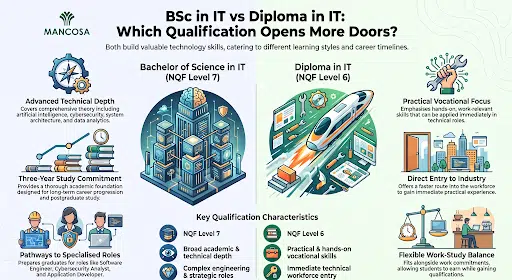
According to the South African Qualifications Authority (SAQA), a traditional Diploma is generally an NQF Level 6 qualification, while a three-year Bachelor’s Degree is at NQF Level 7.
- A Diploma in IT generally has a stronger vocational focus, helping students develop practical skills they can apply in the workplace.
- A BSc IT generally offers broader and more advanced study. For example, MANCOSA’s three-year Bachelor of Science in Information Technology includes programming, artificial intelligence (AI), cybersecurity, data analytics, database development, and system architecture.
2. Career opportunities
When comparing BSc in IT vs IT diploma career opportunities, think about where you would eventually like your career to go.
A BSc in IT can prepare you for careers such as:
- Software Engineer
- Cybersecurity Analyst
- Application Developer
- Business Intelligence Developer
- Network and Computer Administrator
A diploma can provide a pathway into practical and technical IT positions, while also giving you experience that may help you progress over time.
Don’t only think about your first job. Consider where you would like to be five or ten years from now.
3. Time commitment
A bachelor’s degree usually requires a bigger time commitment. For example, MANCOSA’s BSc IT takes three years to complete.
A diploma can provide a more direct route into the workplace and may have a shorter study period (even though some diplomas are also three years). As such, diplomas may appeal to students who want to start gaining practical experience sooner.
4. Flexibility
If your main concern is, “Can I study IT while working full time?”, look closely at how your chosen institution delivers its programmes.
Online and flexible learning options can make it easier to fit your studies around work and other responsibilities.
This means you don’t necessarily have to choose between gaining work experience and continuing your education. You can do both at the same time!
5. Your long-term goals
Imagine two students, Thabo and Lerato.
Thabo wants to become a Software Engineer and eventually move into senior software development and architecture. He chose a BSc IT because he wants a broad foundation in programming, AI, data, cybersecurity, and system architecture.
Lerato wants to enter the technology industry sooner and prefers hands-on learning. She chooses a Diploma in IT, starts building practical experience, and plans to continue developing her qualifications and industry certifications while working.
Neither path is automatically better. The better choice is the one that supports your goals.
So, is a Diploma in IT worth it for career growth? It certainly can be.
However, if you want a broader academic foundation, access to certain postgraduate study opportunities, or careers requiring deeper technical knowledge, a BSc IT may open more doors over the long term.
Why MANCOSA is a top choice for your preferred IT course
Whether you’re starting your IT journey or want to move into a more senior role, MANCOSA offers several IT and digital technology courses to suit different career stages.
The best option for people just starting their IT career is the Bachelor of Science in Information Technology.
One option for experienced graduates is the Postgraduate Diploma in Information and Technology Management. This one-year IT management course is NQF Level 8 and is designed for people already working in IT or those who want to move into IT management.
MANCOSA makes studying more accessible.
Its postgraduate programmes offer flexible online learning, allowing working professionals to study around their existing responsibilities.
Students also benefit from academic support, work-relevant learning, and different payment options to make their studies more manageable.
FAQs
Which IT courses are in demand?
IT courses covering cybersecurity, artificial intelligence (AI), data analytics, cloud computing, and software development are particularly relevant to today’s digital workplace.
When choosing a course, consider both current industry needs and the area of technology you would like to build a career in. Both industry demand and your passions are important.
Is a diploma in IT worth it?
Yes. An IT diploma can be worthwhile if you want practical skills and a more direct route into the technology industry. It can also provide a foundation for further learning as your career develops. For example, you’ll be able to pursue postgraduate studies afterwards.
Which diploma is best for the IT field?
The best option depends on your career goals. For example, MANCOSA’s Postgraduate Diploma in Information and Technology Management is suited to graduates who want to develop their IT management and leadership skills.
Is a diploma better than a bachelor’s degree?
Not necessarily. When comparing an IT degree vs IT diploma, each has benefits. A BSc IT generally provides broader and more in-depth study, while a diploma tends to have a more practical, career-focused approach.
Can I study IT while working full time?
Yes. Flexible and online study options can make it possible to complete an IT qualification while working. MANCOSA’s distance-learning approach is designed to help students fit their studies around work and other responsibilities.
Register for an IT course online
When comparing a BSc IT vs a Diploma in IT, the right choice ultimately depends on your career goals and available time.
A BSc IT may be the better choice if you want a broad understanding of information technology and want to prepare for more advanced technical roles or further study. A diploma, on the other hand, can offer a more practical and focused learning experience.
If you already have a relevant qualification and want to move into IT management, MANCOSA’s Postgraduate Diploma in Information and Technology Management can help you build the technical, business, and leadership knowledge needed to take the next step in your career.
Whichever path you choose, look beyond the qualification itself. Consider where you want your IT career to take you and choose a course that can help you get there.