6 Things to Know About Leadership in the Age of AI
Artificial intelligence is changing the way businesses operate, communicate, and make decisions. From automated customer service to advanced data analysis, AI is now influencing almost every industry. As a result, leadership is evolving too. Enter leadership in the age of AI. Today’s leaders must understand how to work alongside AI, guide teams through digital transformation, and make ethical decisions in fast-changing environments. Businesses are also looking for leaders who can balance technology with human connection, creativity, and emotional intelligence. This shift has made leadership development programmes from institutions like MANCOSA more important than ever before. In this article, we will explore six important leadership pillars for success in the AI era, including adaptability, ethical governance, continuous learning, and the most essential leadership skills for the future of work.

Authors

MANCOSA
Leadership in the Age of AI: 6 Key pillars for success
Artificial intelligence is changing the way businesses operate. From customer service chatbots to advanced data analysis, AI is now part of everyday business decisions.
But while many companies are investing in AI tools, technology alone is not enough. Businesses also need
strong leaders who understand how to guide teams through change.
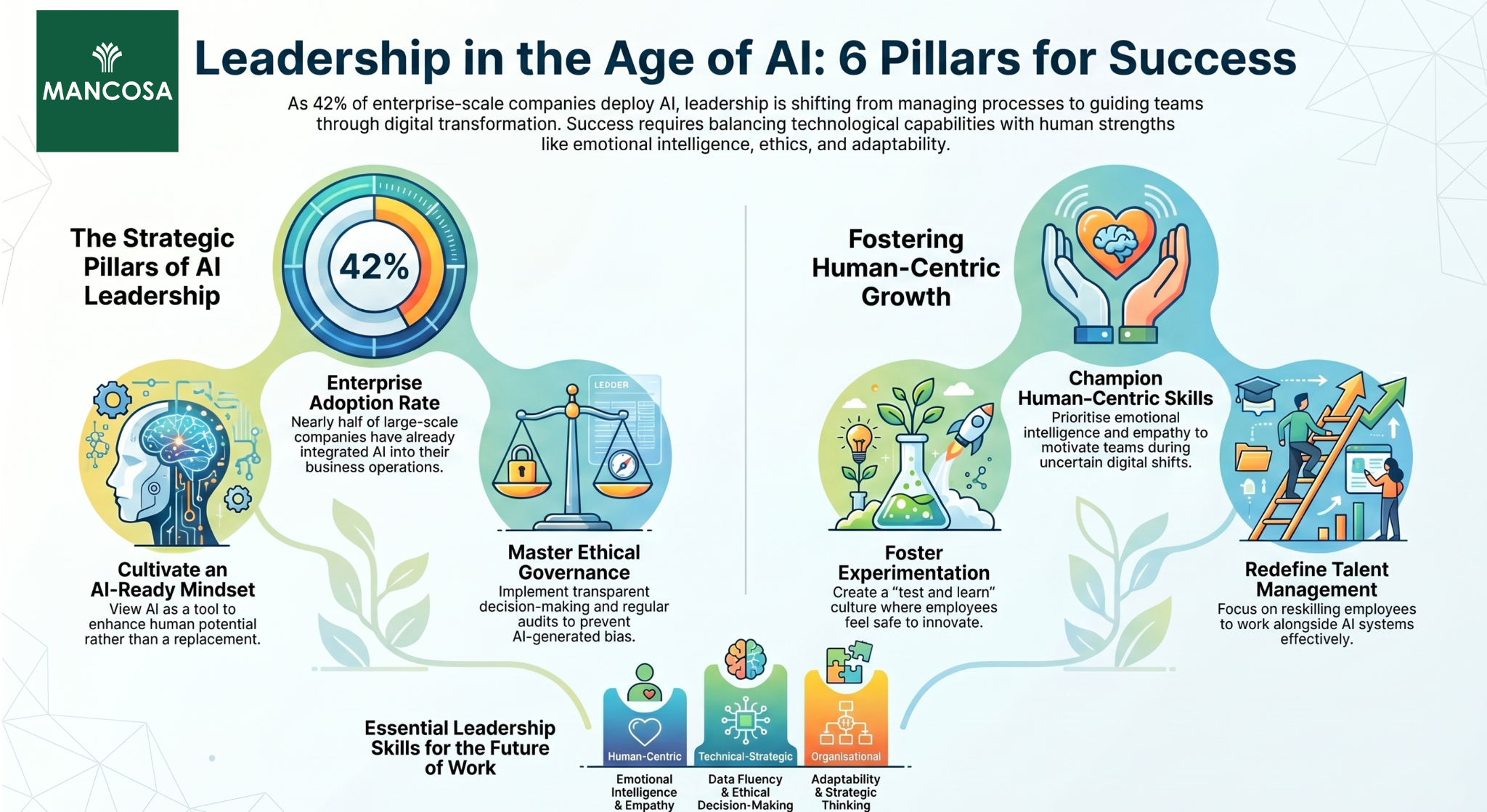
In fact, according to IBM, around 42% of enterprise-scale companies have already actively deployed AI in their business operations. This means leaders can no longer ignore AI or leave it to technical teams alone.
The reality is simple: the companies that thrive in the future will have leaders who know how to combine human strengths with AI capabilities.
Below are six of the most important pillars of successful leadership in the age of AI.
1. Cultivating an AI-ready mindset
One of the most critical skills leaders need in the age of AI is the ability to think strategically about technology.
Successful leaders don’t see AI as a replacement for people. Instead, they see it as a tool that helps employees work smarter and faster.
For example, a marketing manager might use AI to analyse customer trends in minutes rather than spend days on spreadsheets. This gives the team more time to focus on creativity, strategy, and customer relationships.
2. Championing human-centric skills
As AI automates repetitive tasks, human skills are becoming even more valuable. These skills include:
- Emotional intelligence
- Communication
- Empathy
- And adaptability
Employees still need leaders who can motivate teams, handle conflict, and create trust during uncertain times. AI cannot replace genuine human connection.
Imagine a company going through a major digital transformation. Employees may feel anxious about job security or learning new tools. A leader with strong emotional intelligence can reassure staff, communicate clearly, and help teams adapt more confidently.
According to the World Economic Forum Future of Jobs Report, leadership and social influence are among the top workplace skills growing in importance globally.
3. Mastering data fluency and ethical governance
Modern leaders must understand how to interpret data and question AI-generated insights. This doesn’t mean becoming a data scientist, but it does mean understanding how data affects business decisions.
At the same time, ethical AI governance for business leaders is just as important. AI systems can sometimes produce biased or unfair outcomes if they’re not monitored properly.
For example, an AI hiring tool trained on biased historical data could unintentionally favour certain candidates over others. Without ethical oversight, businesses risk damaging employee trust and brand reputation.
Strong AI governance includes:
- Transparent decision-making
- Data privacy protection
- Regular audits for bias
- Clear accountability structures
4. Embracing agility and continuous learning
AI technology evolves rapidly. What works today may become outdated within a year. This is why modern leaders must embrace continuous learning and flexibility. Leaders who succeed in AI-driven environments are willing to adapt quickly, test new ideas, and learn from failure.
This is also where professional development becomes valuable. Many businesses now invest in workshops, executive education, and corporate training solutions, such as leadership in AI, to help managers stay up to date.
5. Fostering a culture of experimentation
Innovation rarely happens in companies where employees are afraid to fail. Strong AI leadership involves fostering a workplace culture that encourages experimentation.
For instance, a small business may test an AI content creation tool for internal marketing campaigns. The first results may not be perfect, but the team gains valuable insights into how the technology works and where human input is still needed.
This “test and learn” mindset enables companies to innovate faster and stay competitive. Leaders who encourage experimentation often discover new ways to improve productivity, customer service, and collaboration.
6. Redefining talent management and upskilling
Finally, leaders must rethink how they develop talent. AI is changing job roles across nearly every industry, requiring employees to acquire new skills to stay relevant.
Understanding how to implement AI in leadership strategy includes helping employees learn how to work alongside AI systems rather than compete against them.
Forward-thinking companies are already investing heavily in reskilling and upskilling programmes.
The most effective leaders are those who identify employee strengths, support continuous learning, and prepare teams for the future workplace.
Why a leadership course from MANCOSA can help you get ahead
Discover corporate training solutions for leadership in AI. Through MANCOSA Corporate Training Solutions, businesses can access future-focused leadership programmes designed specifically for employee development and organisational growth.
These include programmes such as:
- 21st Century Manager Development
- Digital and Innovation Leadership
- Women in Leadership Accelerator
- And more
These programmes cover innovation leadership, emerging leadership, digital leadership, and modern management skills.
One major advantage is flexibility. Many programmes are offered fully online over short study periods, allowing employees to upskill without disrupting their work schedules.
MANCOSA also provides customisable corporate training solutions tailored to a company’s industry, workforce needs, and business goals.
FAQs
What does leadership look like in the age of AI?
Leadership in the age of AI is more focused on people, strategy, and adaptability than simply managing processes. Instead of just being good at leading and motivating teams, modern leaders must also know how to guide teams working alongside AI tools.
Instead of viewing AI as a replacement for employees, effective leaders see it as a tool that enhances human potential and improves decision-making.
What are the 5 critical skills leaders need in the age of AI?
The five most important critical skills leaders need in the age of AI are emotional intelligence, data fluency, ethical decision-making, adaptability, and strategic thinking.
These skills help leaders manage technology-driven workplaces while still supporting employee growth and collaboration. Together, they form some of the most essential leadership skills for the future of work.
What are the 5 C’s of leadership?
The five C’s of leadership are often described as Character, Competence, Clarity, Courage, and Compassion.
In modern workplaces, these qualities help leaders manage uncertainty, communicate effectively, and build stronger teams. A strong leadership course can help professionals develop these skills further.
What is responsible leadership in the age of AI?
Responsible leadership in the age of AI means using technology fairly, ethically, and transparently. Leaders must focus on data privacy, reducing bias in AI systems, and ensuring accountability in business decisions.
Strong ethical AI governance for business leaders helps maintain trust with employees, customers, and stakeholders.
How can corporate training solutions help companies with leadership development in the age of AI?
Modern leadership development is on the rise as it helps businesses prepare managers and employees for rapidly changing workplaces.
These programmes teach leaders how to adapt to AI-driven environments, improve strategic thinking, and implement AI into leadership strategy.
Register for leadership courses online with MANCOSA
Artificial intelligence is transforming the workplace faster than ever before. While technology continues to evolve, strong leadership remains one of the most valuable business assets.
Companies need leaders who can balance innovation with empathy, use data responsibly, and guide teams through ongoing change with confidence.
This means developing the critical skills leaders need in the age of AI.
Through future-focused programmes and corporate training solutions, organisations can prepare managers and employees for the changing world of work while building stronger, more resilient teams.
Have a look at MANCOSA’s leadership training programmes to find out more about how we can help prepare your leaders and managers for work in the age of AI.