Everything You Need to Know About Studying an MBA in 2026 and Beyond
New technologies, AI, and digital transformation are creating both opportunities and challenges for organisations around the world. As a result, businesses need leaders who can think strategically and move them and their teams through uncomfortable changes. This is one reason why the Master of Business Administration (MBA) from an institute like MANCOSA remains one of the most popular postgraduate qualifications for professionals looking to advance their careers.

Authors
MANCOSA
But what does studying a Master’s Degree like the MBA look like in 2026 and beyond? Is it still worth the investment? What skills will you learn, and how can a higher qualification help you achieve your career goals?
In this guide, we’ll explore the five key things you need to know about studying an MBA today, including career benefits, admission requirements, online learning options, and more.
5 Essential things to know about studying an MBA in 2026 and beyond
A Master of Business Administration course (MBA) is one of the most respected business qualifications in the world. It helps professionals build skills beyond what they learned in their undergraduate studies. These include skills in:
- Leadership
- Strategy
- Decision-making
- Adaptability
- Digital literacy
- And many more, such as corporate governance, business ethics, digital transformation, innovation management, strategic Research, global business, organisational change, etc.
For many people, a Master’s Degree is a way to move into management, qualify for senior leadership roles, start a business, or grow their earning potential.
It can also help professionals stay competitive in a world where technology, artificial intelligence (AI), and digital transformation are changing how businesses operate.
If you’re thinking about studying this programme, here are five important things to know in 2026 and beyond.
1. The value of a Master’s Degree has changed
Years ago, people often studied for a Master’s Degree mainly to earn a higher salary.
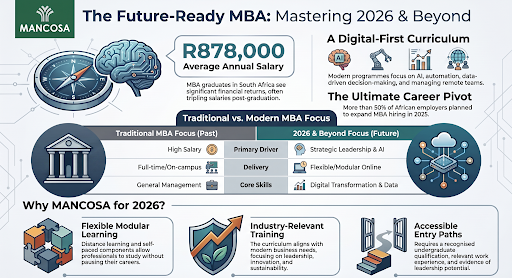
The good news is that Master’s graduates continue to see strong financial returns. Let’s have a look at the Master of Business Administration salary outlook:
While salaries vary by industry, experience level, and location, these graduates often earn significantly more than they did before studying. In South Africa, Payscale estimates the average salary of graduates at around R878,000 per year.
As you can see, while salary growth is still a major benefit, today’s degrees offer much more.
Modern employers are looking for professionals who can solve problems, lead teams, work with data, and adapt to change. As such, Master’s programmes now focus heavily on these skills, making graduates more employable.
Plus, these degrees offer many networking opportunities. This helps you grow relationships that can mean a lot for your career now and in the future.
So, when asking, “Is an MBA worth it in South Africa?“, the answer depends on your goals. For many professionals, the combination of career growth, leadership skills, networking opportunities, and increased earning potential makes it a worthwhile investment.
2. Master’s programmes are becoming more digital
Business has changed dramatically over the last few years. As a result, Master’s curricula have changed too.
Today’s Master’s students learn about:
- Artificial intelligence and automation
- Digital transformation
- Data-driven decision-making
- Innovation and entrepreneurship
- Managing remote and hybrid teams
- Sustainability and responsible business practices
At MANCOSA, students engage with contemporary business challenges through applied learning that integrates digital transformation, artificial intelligence, innovation, sustainability and strategic decision-making. The programme encourages students to evaluate emerging technologies critically while considering their ethical, governance and organisational implications.
According to PubMed Central, AI skills can improve employability and increase salary expectations.
In other words, modern MBA programmes are designed to prepare students for the future, not the past.
3. A Master’s can help you make a career change
One of the biggest reasons professionals enrol in this degree is to change career direction.
Imagine a marketing manager who wants to move into executive leadership. Or an engineer who wants to transition into business management. A Master’s degree can help bridge those gaps by providing broader business knowledge and leadership skills.
This makes a career pivot with a Master’s more achievable than ever.
Many graduates also use their degree to move into:
- Consulting
- Finance
- Technology
- Entrepreneurship
- Or senior management roles
As employers continue to value strategic thinking and problem-solving skills, Master’s graduates remain highly sought after. In fact, more than half of employers in Africa planned to expand MBA hiring in 2025, according to GMAC research
4. Flexible study options are making the Master’s programme more accessible
Not everyone can leave their job to study full-time.
Fortunately, some institutions (like MANCOSA) now offer flexible modular MBA options online, allowing students to balance work, family, and education.
These programmes often include:
- Online learning platforms
- Evening or weekend classes
- Modular course structures
- Self-paced learning components
This flexibility makes it easier for working professionals to earn a Master’s degree without putting their careers on hold.
For example, a project manager can continue working full-time while immediately applying new leadership and strategy concepts in the workplace. This way, they can start benefiting from their studies right away.
5. Understand the admission requirements before applying
Before applying, it’s important to understand the MBA requirements and admission process.
While requirements vary between institutions, most Master’s programmes typically require:
- A recognised undergraduate qualification
- Relevant work experience
- Supporting documents such as a CV and academic transcripts
- In some cases, an interview or additional assessment
- Many institutions also look for evidence of leadership potential and professional experience.
Before submitting your application, review the entry requirements to ensure you meet all criteria.
Why taking a MANCOSA MBA is a smart choice
If you want to grow your career, move into leadership, or build your own business, the MANCOSA Master’s Degree can help you get there.
The programme is designed for working professionals who want to develop advanced business and management skills while continuing to work.
It covers key areas such as leadership, strategy, finance, operations, innovation, and business decision-making.
One of the biggest advantages of studying with MANCOSA is flexibility.
The programme is offered through distance learning. This allows students to balance their studies with work and family commitments, making it an excellent option for busy professionals who need a qualification that fits their lifestyle.
MANCOSA is also known for providing affordable, accessible higher education without compromising on quality.
Students benefit from industry-relevant learning, experienced academics, and a curriculum that aligns with modern business needs (including digital transformation).
Whether your goal is career advancement, entrepreneurship, or executive leadership, the MANCOSA MBA can equip you with the skills and knowledge needed to succeed in today’s competitive business environment.
For more information, visit the MANCOSA Master’s programme page. Alternatively, you can explore other postgraduate business qualifications that can support your career goals, such as:
Why Choose the MANCOSA MBA?
- Flexible distance learning
- Industry-relevant curriculum
- Executive leadership focus
- Applied business research
- Experienced academics
- Digital learning environment
- Career advancement
- Strong alumni network
FAQs
Is a Master’s worth it in South Africa?
Yes. For many professionals, a Master’s is a valuable investment. It can help you build interpersonal and technical skills that modern employers need.
In addition to improving career prospects and earning potential, it can help you adapt to changes in technology, digital transformation, and the modern business environment.
What are the Master’s degree requirements and the admission process?
A Master’s Degree’s requirements and admission process guidelines vary between institutions. Generally, applicants need:
- A relevant NQF Level 8 qualification, such as an Honours Degree or Postgraduate Diploma
- Along with several years of work experience
Some institutions may also consider experienced professionals through Recognition of Prior Learning (RPL) pathways.
What are some flexible modular Master’s options online?
Many business schools now offer flexible modular Master’s options online. These programmes are designed for working professionals who need to balance study, work, and personal commitments.
Online learning allows students to gain advanced business knowledge without putting their careers on hold.
Can I do a career pivot with an MBA in 2026 and beyond?
Yes. A career pivot with this degree in 2026 and beyond is a popular choice for professionals looking to move into leadership roles or change industries.
A Master’s provides broad business knowledge and practical management skills. This then opens the door to career shifts and advancements.
What is the Master of Business Administration salary?
The average Master of Business Administration salary depends on factors such as industry, experience, location, and job role.
However, Master’s graduates often qualify for higher-paying management and executive positions, making the qualification a strong long-term investment in career growth. In South Africa, Payscale estimates the average salary of graduates at around R878,000 per year.
MANCOSA MBA different?
With MANCOSA, you’ll experience:
- Flexible learning
- Industry relevance
- Experienced academics
- Applied research
- Executive focus
- Leadership development
Does the MBA include research?
Yes. Students undertake applied business research addressing real organisational challenges, enabling them to develop practical, evidence-based solutions.
Who is the MBA designed for?
- Working professionals
- Managers
- Business owners
- Entrepreneurs
- Executives
- Aspiring leaders
Register for an MBA online
A Master’s Degree remains one of the most valuable business qualifications for professionals seeking to advance their careers, increase their earning potential, and develop strong leadership skills.
However, the Master’s Degree from 2026 onwards looks different from those of the past.
In today’s rapidly changing business environment, organisations require leaders who can think strategically, lead ethically, embrace innovation and make evidence-based decisions. The MANCOSA MBA equips professionals with these capabilities through a rigorous, industry-relevant curriculum that combines academic excellence with practical application.
Whether your ambition is to advance into executive leadership, transform your organisation or launch your own venture, the MANCOSA MBA provides the knowledge, networks and leadership capabilities to help you achieve your goals.