Skills Development: Read This First If Your Staff Haven’t Studied in Years
If your staff haven’t studied for a long time, the idea of returning to learning can feel overwhelming. They may wonder whether they’re too busy, too old, or too far behind. The truth is that many successful professionals return to learning later in life to build new skills, advance their careers, and stay relevant in a changing workplace. For businesses, investing in staff development is essential since it can improve productivity and drive long-term growth. In this article, we explore why continued skills development matters, the benefits it offers employees and businesses, and how MANCOSA's Skills Development Programmes can help organisations build a future-ready workforce.

Authors
MANCOSA
10 Reasons continued skills development is essential in today’s landscape
Today’s business environment is evolving rapidly. New technologies, artificial intelligence (AI), automation, and digital tools are changing the way organisations operate.
As a result, skills are also changing.
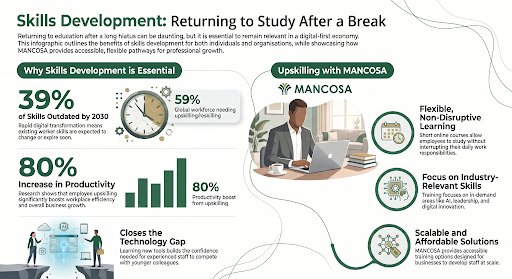
In fact, according to the World Economic Forum, 59% of the global workforce will need some form of upskilling or reskilling during the same period.
As such, both employers and employees need to invest in continuous learning and skill development.
That said, it can feel intimidating for employees if they haven’t studied in years. However, skills development doesn’t mean starting from scratch. It simply means building on the knowledge and experience you already have.
Below are ten reasons why ongoing learning matters for both employees and organisations.
1. It helps employees stay relevant
The skills that helped employees succeed five years ago may not be enough today. Artificial intelligence, automation, and digital tools are changing how work gets done across almost every industry.
According to the World Economic Forum, 39% of workers’ existing skills are expected to change or become outdated by 2030.
This means employees who continue learning are more likely to remain employable, while businesses benefit from a workforce that can adapt to new technologies and ways of working.
2. It builds confidence
Many experienced employees worry that younger colleagues are more comfortable with technology and new ways of working.
Skills development helps close this gap.
As employees learn new tools, systems, and processes, they often become more confident participating in meetings, taking on projects, and applying for promotions. This confidence can have a direct impact on workplace performance.
3. It improves productivity and performance
Employees who receive regular training often work more efficiently and solve problems more effectively. In fact, research shows that employee upskilling improves productivity by 80%. As a result, this aids business growth by enabling teams to perform at a higher level.
4. It supports career advancement
New skills can create opportunities for promotions, leadership roles, and specialised positions. This gives employees access to better jobs and higher salaries, while providing companies with better leaders who can help the organisation thrive. It’s a win-win.
5. It improves employee retention
People are more likely to stay with employers who invest in their growth. In fact, studies continually find that providing learning opportunities is one of the top strategies organisations use to improve retention. This is often more important than a high salary.
6. It encourages innovation
Employees who are exposed to new ideas, technologies, and industry trends are often better equipped to identify opportunities for improvement.
For example, a staff member who completes a course on AI or data analytics may discover ways to automate repetitive tasks, reduce costs, or improve customer service. Small improvements like these can create significant business value over time.
7. It supports digital transformation
The importance of workforce skills development in the digital economy continues to grow as businesses adopt new technologies.
Employees with strong digital skills are far better equipped to help organisations adapt and succeed — regardless of future changes in the market.
8. It creates future leaders
Training programmes help organisations identify employees with leadership potential. By developing these individuals early, companies can build strong leadership pipelines for the future. Explore MANCOSA’s Leadership Development Programmes here.
9. It strengthens business competitiveness
Customer expectations, regulations, and industry trends can change quickly. Organisations with a well-trained workforce are usually able to respond more effectively because employees can learn new processes and take on new responsibilities when needed.
10. It creates a culture of lifelong learning
Sending employees on a single course is valuable. But what’s even better is creating a culture where learning becomes part of everyday work.
Employees are encouraged to share knowledge, experiment with new ideas, and continuously improve. Over time, this helps organisations become more innovative, resilient, and prepared for future challenges.
Why MANCOSA skills development training is a smart choice
For organisations seeking to build a future-ready workforce, MANCOSA’s skills development programmes offer practical, flexible learning opportunities tailored to today’s business environment.
These programmes are aimed at companies that want to upskill, reskill, and develop their employees while supporting long-term business growth.
Some key benefits include the following:
- MANCOSA’s skills development programmes focus on industry-relevant knowledge and workplace-ready skills. This helps employees stay competitive in a job market shaped by digital transformation, automation, artificial intelligence, and changing customer expectations.
- One of the biggest advantages is flexibility. Companies can choose from short online courses, formal learning programmes, or customised training solutions that align with specific business goals and workforce needs. This allows employees to learn without disrupting their daily responsibilities.
- MANCOSA also offers affordable and accessible learning options, making it easier for businesses to invest in staff development at scale. Popular focus areas include leadership development, digital innovation, project management, communication, workplace readiness, and AI-related skills.
To explore available training options, visit MANCOSA’s Skills Development Programme page or browse its Leadership Development Programmes.
Whether your goal is to strengthen leadership pipelines, improve productivity, or prepare your workforce for future challenges, MANCOSA provides practical training solutions that deliver measurable business value.
FAQs
Why is continuous skills development important in today’s workplace?
Workplaces are changing quickly due to technology, automation, and artificial intelligence. Continuous learning helps employees keep their skills up to date and remain effective in their roles. It also supports career growth by building abilities that are highly valued by employers.
For businesses, skills development builds a stronger, more productive, and more adaptable workforce for changing markets.
How does staff skills development training benefit businesses?
Staff training helps employees work more efficiently, solve problems faster, and adapt to change. It also encourages innovation and improves employee engagement.
These are some of the key benefits of continuous skills development for employees and businesses, helping organisations stay competitive and future-ready.
Can employees return to studying after being out of education for many years?
Yes. Many learning programmes are designed for working professionals who have not studied for a long time.
Professional development training for workers returning to study often includes flexible online learning, allowing employees to balance their studies with work and family commitments.
What types of skills training are most valuable for employees today?
Some of the most valuable areas include leadership, communication, project management, digital literacy, AI, problem-solving, and industry-specific technical skills. These competencies help employees remain relevant and prepared for changing workplace demands.
How does investing in employee training support long-term business growth?
Employee development helps create a skilled, motivated, and adaptable workforce.
This demonstrates how employee upskilling improves productivity and business growth by improving performance, supporting innovation, and helping organisations respond more effectively to new opportunities and challenges.
Register for a skills development course with MANCOSA
In today’s fast-changing workplace, continued skills development is one of the best ways to keep your workforce relevant, confident, and prepared for future opportunities.
Whether you’re an employee who has not studied in years or an organisation looking to strengthen your workforce, investing in learning can deliver long-term benefits.
The good news is that learning is now more accessible than ever. Flexible online programmes make it possible to develop in-demand skills without putting your career or business on hold. Have a look at MANCOSA’s Skills Development Programmes here.