The Complete Guide to Funding Your College Studies in South Africa
Funding your higher education - from your Undergraduate Degree and beyond - is one of the biggest challenges many students face today. Tuition fees, study materials, and everyday living costs can quickly add up, leaving many wondering how to pay for college without putting themselves or their families under financial pressure. In South Africa, this challenge can be even more complex, especially for students exploring college funding options at private institutions. Without careful planning, paying for college can feel overwhelming.

Authors

MANCOSA
The good news is that there are practical and accessible ways to make your Undergraduate Degree studies with institutions like MANCOSA possible. From flexible payment options to working while studying, there are multiple paths you can take.
This guide will walk you through realistic strategies to help you understand your options and make informed decisions about funding your undergraduate studies.
7 Practical ways to fund your Undergraduate Degree
Paying for tertiary education is one of the biggest challenges many South African students face. Tuition fees, study materials, internet access, and living costs can quickly add up.
According to Statistics South Africa, many households already struggle with basic living expenses, which makes it even harder to set aside money for higher education. This often leaves students asking:
- What is the best way to fund college?
- How can I realistically pay for my studies without financial stress?
The good news is that there are several practical options available. If you’re wondering how to pay for college or looking for student funding for private colleges in South Africa, here are seven realistic ways to consider.
1. Bank student loans
Commercial banks in South Africa offer student loans designed to cover tuition, textbooks, and other study-related costs.
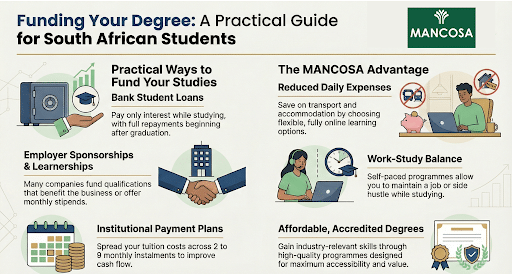
Institutions such as Standard Bank and Absa offer structured repayment plans. In many cases, you only pay interest while studying, and begin full repayments after graduation.
For example, a student gets accepted into a business degree but cannot pay up front. They apply for a student loan to cover their tuition. While studying, they pay a small monthly interest. After graduating and getting a job, they begin full repayments.
How to apply for a student loan at a bank:
- Provide proof of acceptance from your institution
- Submit your ID and financial documents
- Have a guarantor (such as a parent or guardian)
For the best and most affordable student loan, compare interest rates and repayment terms before choosing a loan.
2. Employer sponsorships and learnerships
Some companies invest in their employees’ education, especially when the qualification will benefit the business.
Learnerships are another option. These combine:
- Practical work experience
- Formal study
- A monthly stipend
Many programmes are registered with the Sector Education and Training Authority bodies, which support skills development across industries.
Expert tip: If you’re already working, speak to your employer about study support — even partial funding can make a big difference.
3. Personal savings and family contributions
Using personal savings or family support is one of the most common ways to fund studies.
While it may not cover everything, it can:
- Reduce how much you need to borrow
- Lower financial pressure after graduation
Speaking of small savings, studying online can also help reduce costs like:
- Transport
- Accommodation
- Daily expenses
Even small monthly savings started early can grow into a meaningful education fund.
4. Crowdfunding and community support
Some students turn to crowdfunding platforms or community networks to raise funds.
This can include:
- Online fundraising campaigns
- Support from local organisations or churches
- Community sponsorships
While this is less traditional, it can help cover:
- Registration fees
- Study materials
- Short-term funding gaps
For example, a student may raise part of their registration fee through a community fundraiser, allowing them to secure their place while arranging the rest of their funding.
5. Educational investment plans
Families who plan ahead often use investment products designed specifically for education. These plans allow money to grow over time through:
- Interest
- Long-term investment returns
Starting early (even during childhood) can make a big difference when it’s time to pay for university.
Expert tip: Speak to a financial advisor to choose an investment plan that aligns with your long-term education goals.
6. Part-time or side hustles
Working while studying can help cover daily expenses and reduce reliance on loans. Options include:
- Part-time jobs
- Freelancing
- Small online businesses
The flexibility of online degrees makes it easier to balance work and studies. Even earning a small monthly income can help pay for data, textbooks, or transport.
7. Institutional payment plans
Many private institutions often offer flexible payment options.
Instead of paying everything up front, you can:
- Pay in monthly instalments
- Spread costs across the academic year
This helps with cash flow and makes studying more manageable. Always ask your institution about payment plans before enrolling. For example, MANCOSA offers payment plans ranging from 2 to 9 monthly instalments.
Why studying a MANCOSA Undergraduate Degree is a smart financial choice
Choosing where to study is not just about getting a qualification — it’s also about making a smart financial decision that supports your future.
If you’re asking “What is the best way to fund college?”, part of the answer is choosing an institution that gives you strong value for money, flexibility, and real career outcomes.
An Undergraduate Degree from MANCOSA is designed to do exactly that. You can explore our full range of programmes here:
Here are some of the benefits of studying with MANCOSA:
- Affordable, high-quality education: One of the biggest concerns for students is cost. MANCOSA is known for offering affordable, accredited programmes that are accessible to a wide range of students.
- Flexible online learning (save more while you study): MANCOSA offers fully online and flexible learning options, allowing students to study from anywhere. This flexibility helps you save money on transport, accommodation, and daily expenses.
- Future-focused, industry-relevant degrees: MANCOSA programmes are designed with input from industry experts, ensuring students gain up-to-date, job-ready skills. You can choose from fields such as business and management, education, information technology, and healthcare.
- Wide range of career-driven programmes: MANCOSA offers a variety of Undergraduate Degrees, including: Bachelor of Business Administration, Bachelor of Commerce (various specialisations), Bachelor of Education, and IT and digital technology Degrees.
- Study at your own pace while building your career: MANCOSA programmes are designed for school leavers, working professionals, and career changers. With self-paced learning, you can balance work, family responsibilities, and your studies.
FAQs
Where can I get funding for my studies in South Africa?
You can access college funding through several practical options, such as bank student loans, employer sponsorships, personal savings, and flexible payment plans offered by private institutions.
Some students also use part-time work or community support to cover smaller costs. If you’re studying towards an online Bachelor’s Degree, these options can be easier to manage because of the flexibility to work while studying.
What is the best way to fund college?
The best approach to paying for college is usually a combination of funding sources.
For example, you might use a student loan for tuition, while covering living expenses through part-time work or savings. This reduces financial pressure and makes paying for college more manageable over time.
However, you can also choose to study online through reputable institutions like MANCOSA, meaning you won’t have to pay for accommodation or transportation.
What should be the main source of funding for your studies?
Your main source of college funding should be the most reliable and sustainable option available to you, such as a student loan, employer support, or structured payment plan.
It should cover your core costs, while other sources (like savings or side income) support additional expenses.
How can I start an education investment plan?
To start paying for college early, consider opening an education-focused savings or investment account. Contribute regularly, even in small amounts, and allow it to grow over time. Starting early can significantly reduce the financial burden when it’s time to enrol.
Register for an Undergraduate Degree online
Taking the next step in your education journey starts with making a confident and informed decision. Once you understand your college funding options and have a clear plan for paying for college, registering for your degree becomes much more achievable.
Studying an online bachelor’s degree offers a practical way to manage how to pay for college, as it allows you to reduce costs and, in many cases, earn an income while you study.
With flexible learning, you can balance your studies with work and other responsibilities, making your education more accessible and sustainable.
If you’re ready to move forward, explore your Undergraduate programme options and begin the registration process. By taking action today, you’re not just enrolling in a qualification — you’re investing in your future, your skills, and your long-term career growth.