5 Ways Robotics and Coding Are Changing Education
Technology is changing how we work, communicate, and solve everyday problems. As a result, schools also need to prepare learners for a future where digital skills will play an increasingly important role. To do so, schools need teachers who understand technology and can teach it effectively. Learning robotics and coding for education from an institute like MANCOSA can help bridge this gap.
Authors
MANCOSA
In this article, we look at five ways robotics is changing education, how they prepare school learners for the Fourth Industrial Revolution (4IR), and why educators need to continue developing their own digital teaching skills.
What is robotics and coding in education?
Robotics and coding in education involve teaching school learners how technology works and how they can use it to solve problems.
Coding teaches learners how to create instructions that computers can follow. Robotics takes this a step further by allowing them to use code to control machines and complete specific tasks.
In other words, learners aren’t simply using technology. They are learning how to create and control it.
Building digital and problem-solving skills
These subjects go beyond simply teaching you how to use technology.
They encourage developing essential 21st-century skills through robotics education, including critical thinking, creativity, collaboration, and problem-solving.
For example, learners may need to:
- Break a large problem into smaller steps
- Create a solution
- Test it and fix any errors
This is known as computational thinking. South Africa’s Department of Basic Education (DBE) includes computational thinking as an important part of its Coding and Robotics curriculum.
Preparing learners with 4IR skills
Robotics can also help prepare school learners for the Fourth Industrial Revolution (4IR). Technologies such as automation and artificial intelligence are changing how people live and work. This means digital and STEM skills are becoming increasingly valuable.
The benefits of integrating robotics and coding into the school curriculum include giving learners practical experience with technology from a young age.
In fact, South Africa’s Coding and Robotics CAPS was officially gazetted in June 2024, with implementation in the Foundation Phase being scaled from 2026.
However, introducing these subjects into schools also creates a new need: teachers must know how to teach them.
Educators need to understand the technology themselves while also knowing how to guide learners through projects, problem-solving, and trial and error. This is where specialised robotics training for educators becomes important.
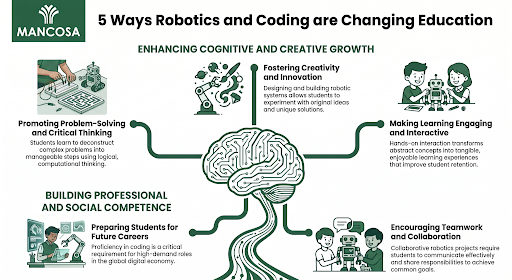
5 Ways robotics and coding are changing education today
Robotics and coding are changing what school learners study and how they learn. At the same time, these changes are creating new skill requirements for teachers.
Here are five ways robotics is changing education today.
1. Learning is becoming more hands-on
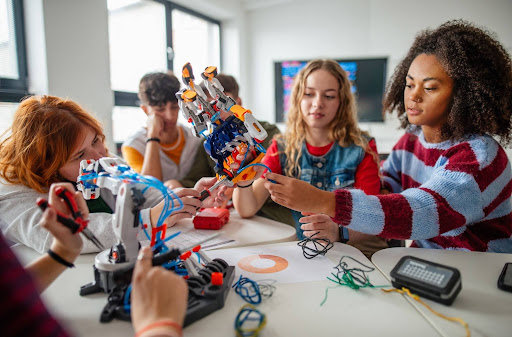
Coding and robotics encourage learners to learn by doing. Instead of only reading about a concept, they can write code, build something, and test whether it works.
A 2024 systematic review and meta-analysis found that educational robotics had a moderate positive effect on the development of STEM competencies among primary school learners.
2. Mistakes become part of the learning process
When code doesn’t work, learners need to identify the problem, make changes, and try again. This helps turn mistakes into opportunities to develop problem-solving and computational thinking skills.
For example, a learner programmes a robot to move around an obstacle, but it turns too early. Instead of simply receiving an incorrect mark, they can adjust their instructions and test the robot again.
3. Abstract concepts become easier to understand
Robotics can also make subjects such as mathematics, science, and technology more practical. Learners can see how concepts such as measurement, sequencing, and logic work in real situations rather than only learning the theory.
4. Learners develop skills for a digital workplace
Many robotics activities involve working together to plan, build, and troubleshoot projects. This can help learners practise communication and creativity alongside technical skills.
These abilities are increasingly important as technology changes the workplace. UNESCO identifies problem-solving, collaboration, digital content creation, and information literacy as important areas of digital competence.
5. Teachers need to develop new skills too
The first four changes affect how learners experience education. But robotics is also changing the role of the educator.
Teachers need to understand how robotics and coding work so they can confidently guide learners through practical activities, projects, and problems.
This means educators may need to upskill as these subjects become more common in South African classrooms.
Flexible coding and robotics facilitator training for working professionals can provide a practical way to develop these skills.
An online Higher Certificate in Robotics and Coding for teachers can also help teachers build their technical knowledge while learning how to apply it in an educational setting.
Pro tip for educators: You don’t need to know the solution to every coding problem. Working through a problem with your learners can demonstrate valuable skills such as research, experimentation, and persistence.
Why MANCOSA is a smart choice for your robotics and coding course
As robotics becomes more important in South African schools, educators need the right skills to teach these subjects confidently.
MANCOSA’s Higher Certificate in Robotics and Coding in Education is a one-year, NQF Level 5 qualification designed to build practical knowledge in this area.
The curriculum covers topics such as teaching methodologies for coding and robotics, robotic skills, algorithms and coding, problem-solving and assistive technology.
For in-service teachers, this provides an opportunity to develop skills that can be applied in the classroom. The programme is offered through distance learning with online support, making it easier for working educators to continue their studies without putting their careers on hold.
For those interested specifically in programming and software development, MANCOSA also offers a separate Higher Certificate in Coding.
FAQs
How do robotics and coding prepare students for the 4th Industrial Revolution in South Africa?
Robotics helps students develop digital literacy, computational thinking, and problem-solving skills. These abilities can prepare learners for a 4IR workplace where automation and artificial intelligence are increasingly common.
What are the primary career benefits of learning robotics?
Robotics skills can support careers in areas such as technology, engineering, software development, automation, and digital education. They also develop transferable skills, including logical thinking, creativity, and problem-solving.
Why are coding and robotics becoming essential in modern education?
Coding and robotics teach learners how technology works rather than simply how to use it. They also encourage experimentation and teamwork, helping learners build skills they can use in further education and future careers.
How can a higher certificate in coding boost my employment prospects?
A higher certificate can provide formal training in coding and related digital skills. It can help demonstrate your knowledge to potential employers and may prepare you for further studies or entry-level opportunities in technology-related fields. Discover whether studying coding is worth it for you.
Can I study robotics online while working as a teacher?
Yes. Flexible online study can make it easier for working educators to develop new skills without leaving their jobs.
For example, MANCOSA’s Higher Certificate in Robotics and Coding in Education uses distance learning, allowing educators to balance their studies with existing work commitments.
Register for an online Higher Certificate course in coding and robotics
Robotics is changing education by making learning more practical, interactive, and focused on problem-solving. For school learners, these subjects can develop valuable skills such as critical thinking, creativity, collaboration, and digital literacy.
But learners are only one part of the equation.
Educators also need the skills and confidence to teach these subjects effectively. As robotics becomes more common in South African classrooms, teachers may need to continue developing their technical and teaching knowledge.
MANCOSA’s Higher Certificate in Robotics and Coding in Education provides an opportunity for educators to build these skills. With flexible distance learning, working professionals can develop their knowledge while continuing with their careers.